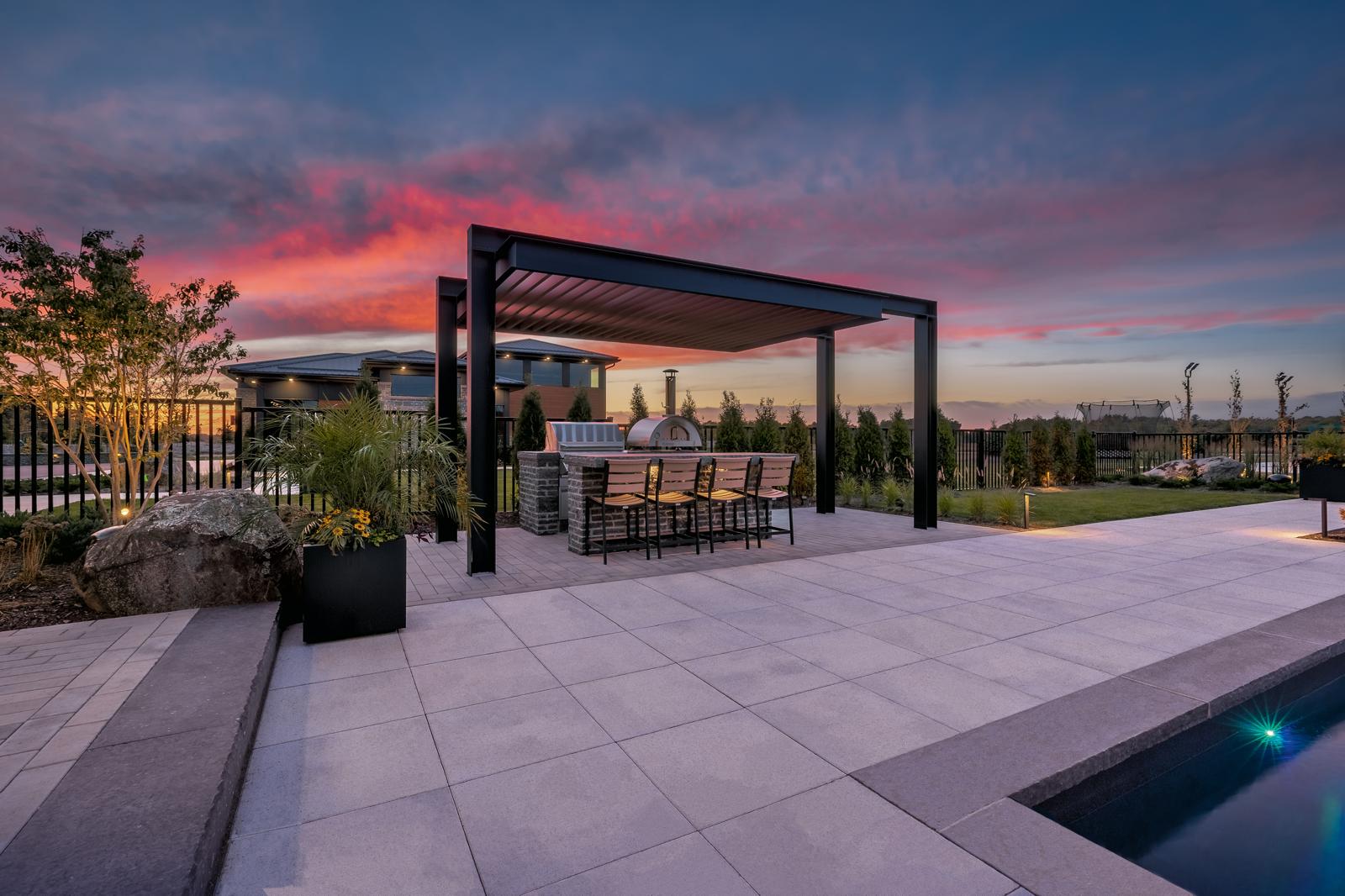
In Ontario's climate, what happens beneath your patio matters as much as what sits on top. Water that cannot escape becomes ice. Ice expands. And expansion causes heaving, cracking, and structural failure. This is why we often specify open-graded aggregate systems for our hardscape installations.
Understanding Open-Graded Aggregate
Open-graded aggregate refers to crushed stone with uniform particle sizes and minimal fine material. Unlike dense-graded bases that compact into a nearly solid mass, open-graded systems maintain consistent void spaces between particles. These voids allow water to move freely through the base rather than becoming trapped.
The technical term for this property is permeability. A properly installed open-graded base can drain thousands of litres of water per hour, directing moisture away from the surface and into the subgrade or drainage system below.
Why Drainage Determines Durability
Simcoe County experiences significant freeze-thaw cycles each winter. When water saturates a traditional dense-graded base, it has nowhere to go. As temperatures drop, that trapped water freezes and expands with considerable force. This expansion lifts pavers, cracks mortar joints, and compromises the structural integrity of the entire installation.
Open-graded systems eliminate this problem by ensuring water never accumulates in the first place. Moisture passes through the base material and disperses into the soil below or exits through perimeter drains. The result is a base that remains stable through the harshest winters.
Performance Through Ontario Winters
We have observed marked differences in long-term performance between installations using open-graded systems and those relying on conventional approaches. Projects built on properly specified open-graded bases show minimal movement even after multiple winter seasons. The surface remains level. Joints stay tight. The installation continues to perform as intended.
This consistency matters because hardscape failures are rarely immediate. A base that traps water may look fine for the first year or two. Problems emerge gradually as repeated freeze-thaw cycles take their toll. By the time visible damage appears, the underlying structure has often been compromised beyond simple repair.
When We Specify This Approach
Not every project requires an open-graded system. Site conditions, soil types, and drainage patterns all influence the appropriate specification. However, we consistently recommend this approach for projects where long-term performance is the priority, particularly in areas with poor natural drainage or where water management presents challenges.
The decision involves evaluating the specific characteristics of each site. We assess existing drainage patterns, soil composition, and the relationship between the proposed hardscape and surrounding grades. This analysis informs our recommendation and ensures the base system matches the demands of the location.
A Foundation for Longevity
The base system is the foundation upon which everything else rests. Premium pavers installed on an inadequate base will eventually fail. Modest materials installed on a properly engineered base will provide years of reliable service. We focus on getting the foundation right because it determines the lifespan of the entire project.
Open-graded aggregate systems represent one approach within our broader commitment to structural integrity. Combined with proper excavation depth, appropriate geotextile separation, and careful attention to compaction, these systems deliver the durability that Ontario conditions demand.
Built for Performance
Every project we undertake begins with a thorough assessment of site conditions and structural requirements. If you are considering a hardscape project and want to understand the approach best suited to your property, we welcome the conversation.
Request a Consultation