
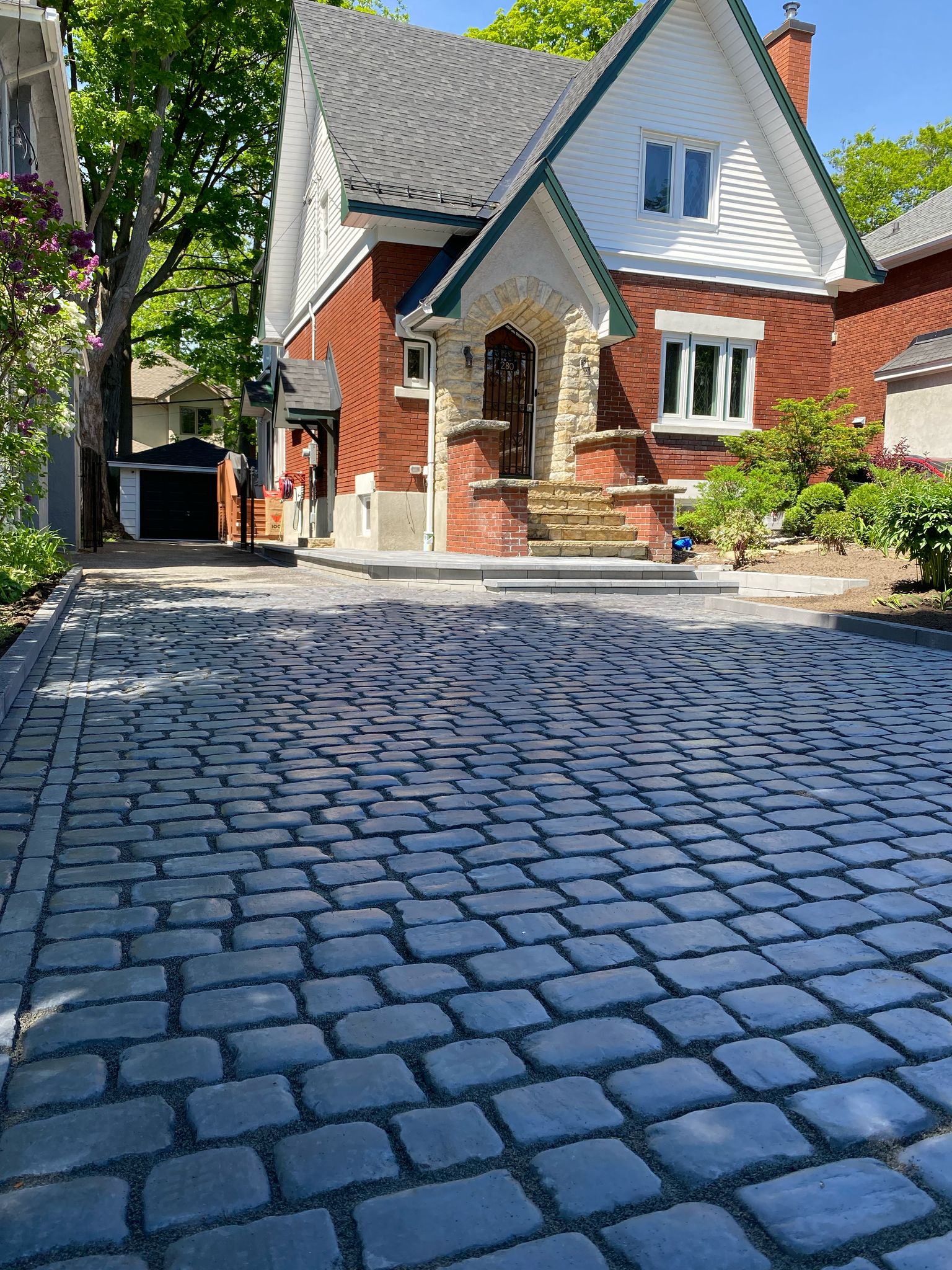
In Barrie, the best months to start a landscaping project are late April through May and September through early October. Late April gives you the first viable ground after frost break. September offers dry, settled soil and booking lead times of 3 to 5 weeks versus 8 to 14 weeks in peak summer. If you want a May start date, book by early March. If a September slot works, a deposit in August is usually enough to secure a spot.
Every spring we get a wave of calls in April from people who want their patio done before the May long weekend. The answer is almost always the same: if you called in January or February, we can fit you in — but if you called last week, the spring schedule is already full. Barrie's outdoor construction season runs from roughly late April to early November, and where you fall in that window shapes everything from crew availability to material lead times to how well your base compacts under real Simcoe County conditions.
Barrie sits on clay-heavy soils that freeze 60 to 90 centimetres deep in a hard winter. Those soils hold moisture long after the snow melts, and they compact differently from the sandier ground you find further south along the Highway 400 corridor. A project started too early runs into wet, unstable subgrade that shifts once the ground dries. A project that runs too late risks polymeric sand that never cures before the first hard frost. Timing is not a preference — it is part of the structural spec.
Below we break down what each part of the season looks like from our side of the excavator: ground conditions, booking lead times, and the practical trade-offs for each window. If you have already scoped your project, try our cost estimator before you call — it helps us quote faster when we do the site visit.
Why Barrie's Freeze-Thaw Cycle Sets Hard Limits on Start Dates
Barrie is one of the snowiest cities in Ontario — the airport records an average of 280 centimetres of snowfall annually, and the hard frost season runs longer here than in most of Southern Ontario. The workable construction window for interlocking driveways, paver patios, retaining walls, and composite decks typically runs from the last week of April through to around October 20 — a span of roughly 26 weeks.
Two hard limits define that window. At the early end, the ground must be firm enough to hold compaction under machinery and base aggregate. Barrie's clay soils do not shed winter moisture quickly — even after a frost break in mid-April, the top 300 millimetres of subgrade can register 2 to 4°C and remain saturated. A practical field test: if a boot heel sinks more than 40 millimetres under normal walking load, the subgrade is too wet to compact correctly. We typically wait 10 to 21 days after temperatures consistently hold above 5°C before starting any base work.
At the late end, the constraint is polymeric sand. Techo-Bloc, Unilock, and Permacon all specify that polymeric sand must be applied and activated at a minimum air temperature of 5°C, with the sand staying above 2°C for at least 24 hours after watering. In Barrie, nighttime temperatures drop below that threshold around October 20 in a typical year. Installing past that point leaves paver joints soft and vulnerable to winter heave — a problem that shows up the following spring when you notice gaps and shifting along joint lines.
Everything between those two limits is workable, but not equally good. Ground conditions, booking competition, and material delivery timelines all vary significantly across the season. Understanding those differences helps you choose the window that fits your project type and your own timeline, rather than discovering the constraints after you have already called around for quotes.
April and May — The First Window Opens
The first viable week for most Barrie landscaping projects falls between April 22 and May 5 in a typical year, though a cold spring can push that to mid-May. We base that judgment on ground temperature at 300 millimetres depth, not surface air temperature — clay soils in Barrie often read 2 to 4°C at that depth even when daytime air temperatures reach 12°C. Compacting aggregate into cold, wet clay creates a base layer that shifts once the ground warms and dries, which is one of the leading causes of uneven settlement in year two or three of a paver installation.
When the ground is ready, early May is genuinely excellent. The Permacon, Unilock, and Techo-Bloc bases we build — typically 300 to 400 millimetres of compacted clear stone — set up well in the stable, moderate temperatures before summer heat arrives. Crews work efficiently, concrete capping and step work cure cleanly, and the finished base has the entire remaining season ahead of it to consolidate before its first winter.
The catch is booking. If you want a May install date, your deposit needs to be in by early March — ideally mid-February. Our spring schedule fills in January and February, when people are getting quotes during the off-season planning window. By the time snow melts in April, spring availability is usually limited to cancellations. Winter is the time to plan; spring is the time to build.
Late April and early May also carry the most weather-delay risk of the season. A week of rain or an unexpected cold snap can push a start date 5 to 10 business days. We build that buffer into scheduling, but it means early-season projects need flexibility from the client's side. Setting a firm completion deadline for a May long weekend event is a risky constraint to impose on an April project start.
June to August — Peak Season Trade-offs
Summer is our highest-output period. We run 3 to 4 field crews simultaneously, and the combination of long daylight hours and stable weather makes project timelines predictable. A typical 37-square-metre interlocking patio takes 4 to 6 working days in July, compared to 5 to 8 days in May when weather monitoring requires more built-in buffers.
The trade-off is demand. From June through August, booking lead times run 8 to 14 weeks. If you call us in June wanting a summer slot, you are looking at late August at the earliest — and more likely a September start before we can schedule. This is not a capacity problem; it is supply and demand for skilled crews across Simcoe County. Aggregate delivery from Carr Landscape Depot in Barrie also tightens in peak season — specific Unilock and Techo-Bloc finishes that are stocked year-round can see 10 to 21-day lead times on certain product lines during July and August.
Summer heat creates one installation challenge worth flagging: polymeric sand application above 30°C requires careful timing. Direct sunlight accelerates the curing reaction, which is fine when the sand is properly seated and watered in sequence, but problematic if any delay opens up between joint filling and activation. We schedule polymeric sand work for early mornings during heat waves and delay application entirely if rain is forecast within 24 hours.
If your target is a summer project, the planning process needs to start in March or April. Use our project cost estimator to frame a rough budget, then book a site visit to get a hard quote before the spring schedule closes. Calling in June for June work is, in nearly every case, too late to get your first-choice window.
September and October — The Best-Kept Scheduling Secret in Simcoe County
September is our favourite installation month. Air temperatures run 10 to 22°C through most of September — the ideal range for both aggregate compaction and polymeric sand activation. The soil is dry from a full summer without freeze-thaw cycles, which means cleaner excavation, better aggregate consolidation, and fewer mid-project weather suspensions. Booking pressure also drops nearly overnight after Labour Day.
In September, booking lead times typically drop to 3 to 5 weeks compared to 8 to 14 weeks in peak summer. A homeowner who decides in late August can often have a crew on site by the second or third week of September. For projects where outdoor entertaining season is not the primary driver — a driveway replacement, a front walkway, a retaining wall along the property line — fall timing is often the best recommendation we can give for both scheduling flexibility and installation quality.
October is viable, but the window narrows to roughly the first 15 to 20 days of the month. Past October 20 in a typical Barrie year, nighttime temperatures make polymeric sand application unreliable. We will install base and pavers right up to that date, but we will not apply polymeric sand within 5 days of a forecast frost. A project that runs into the cutoff can have sand deferred to the following spring — which some clients plan for intentionally, using fall to complete the base and spring to finish the surface.
One practical benefit worth noting: fall-installed bases tend to consolidate well over winter. A September project goes through one full freeze-thaw season before heavy traffic, which is actually favourable for long-term performance. For more detail on why installation timing matters for base quality, see our guide on patio installation timing in Ontario.
How Far Ahead Should You Book a Barrie Landscaper?
The most common question we get after discussing timing is simple: how far in advance do I need to call? The answer depends entirely on when you want the work done.
- Winter (November to March): No field work, but quotes, design reviews, and deposit bookings are fully active. A deposit paid in January or February locks the best spring slot. Deposits are typically 15 to 25% of total project value.
- Spring (April to May): Projects starting now were booked in winter. Lead times for new requests run 6 to 10 weeks, subject to cancellations in the closer dates.
- Peak summer (June to August): Lead times are 8 to 14 weeks. Material delivery can add another 10 to 21 days depending on the product line and finish.
- Early fall (September to October 20): Lead times drop to 3 to 5 weeks. October installs require commitment by early September to protect against the polymeric sand frost cutoff around October 20.
The two most common scheduling mistakes we see: calling in June for August work (August was booked in March), and calling in late September for a mid-October project without accounting for the hard cutoff date. Both scenarios depend on cancellations rather than planned scheduling, and both carry real risk of a compressed or weather-interrupted finish.
If you are reading this in fall or winter, contact us now to get a spring project on the calendar. The initial site visit is at no charge, and a winter deposit gives you first access to the spring booking list before the April demand spike. That one call in January is worth more to your timeline than a dozen calls in April.
Month-by-month installation conditions for Barrie landscaping projects
| Month | Ground Condition | Polymeric Sand Risk | Booking Lead Time | Best For |
|---|---|---|---|---|
| April (late) | Soft, drying | Low to moderate | 2 to 4 weeks | Early starters with flexible dates |
| May | Firm and ideal | Low | 6 to 10 weeks | Spring installs booked in winter |
| June | Firm and warm | Very low | 8 to 12 weeks | Projects planned in March or April |
| July | Warm and dry | Low (heat caution) | 10 to 14 weeks | Any project type; booked in spring |
| August | Hot and dry | Low (heat caution) | 10 to 14 weeks | Driveways and walls |
| September | Dry and settled | Very low | 3 to 5 weeks | Best overall month for most projects |
| October (early) | Cooling, dry | Moderate after Oct 20 | 2 to 3 weeks | Driveways and walls before sand cutoff |
| November | Frost risk | High — avoid | By arrangement | Base prep only; no surface finish |
Frequently Asked Questions
Can you start landscaping work in March in Barrie?
Not for field work. In Barrie, the ground remains frozen or deeply saturated through March in most years, and compacting aggregate into frozen or wet clay creates a base that shifts after thaw. We use March for quoting, design reviews, and deposit bookings. If you want a spring start date, March is exactly when to call — not when to break ground.
What happens if frost hits during an interlocking paver installation?
A frost during base gravel compaction is manageable — we cover aggregate with insulating blankets and resume once temperatures return above 5°C. A frost during or within 24 hours of polymeric sand application is more serious: the bonding agents will not cure correctly and the joints stay soft, leaving them vulnerable to winter heave. If frost is forecast within that 24-hour window, we delay the sand application rather than risk a redo.
Is fall the cheapest time to hire a landscaper in Barrie?
Labour rates do not change by season — our contract rates are consistent year-round. What changes in fall is scheduling flexibility. In September, we have more available dates and less pressure to compress timelines. You will not get a seasonal discount, but you get shorter wait times of 3 to 5 weeks, better ground conditions, and a crew that is not racing the peak-season backlog.
What is the latest date to install an interlocking patio in Barrie?
Our practical cutoff for polymeric sand application is around October 20 in a typical Barrie year. We can install base and pavers right up to that date, but we will not apply polymeric sand when nighttime temperatures are consistently dropping below 3°C. A project that runs into the cutoff can have sand deferred to the following spring — which some clients plan for intentionally to split the work across two invoices.
How do I lock in a spring landscaping slot over the winter?
Contact the contractor in January or February, get a written quote, and pay a deposit — typically 15 to 25% of total project value. That deposit holds your position on the spring schedule. Without a deposit, verbal commitments carry little weight once spring call volume picks up in March and April. The earlier in the off-season you move, the better your slot on the spring calendar.
Does the type of landscaping project affect the best start month?
Yes. Composite decks using TimberTech framing and decking can be installed in a wider temperature range than paver projects because there is no polymeric sand involved — we have done deck installs into early November without issue. Retaining walls and paver driveways follow the same frost-break timing as patios. Concrete steps and capping require air temperatures above 10°C for a proper cure. Your specific project type is worth discussing when you call.
Can interlocking pavers be installed in light rain?
Base gravel and aggregate work continues in light rain — moisture does not affect compaction the way wet clay subgrade does. Polymeric sand is the constraint: it cannot be applied if rain is forecast within 24 hours of activation, and it must be swept and watered into the joints without rainfall diluting the bonding agents. We monitor forecasts closely and hold all sand-application days whenever there is measurable rain risk in the 24-hour window.

Yorkis Estevez founded Golden Maple Landscaping in 2020 and has since installed hundreds of paver driveways, patios, and retaining walls across Barrie and Simcoe County. We carry $5 million in liability coverage, hold WSIB certification for all field work, and maintain a 5.0 Google rating by being straight with clients about what is actually achievable in each season.
If you are planning a landscaping project in Barrie or anywhere across Simcoe County, the best time to start the conversation is right now. We book spring slots through the winter, and fall windows fill faster than most people expect. Reach out through our contact page to schedule a no-charge site visit, and we will give you an honest picture of what the timeline looks like for your specific scope and location. You can also try our project cost estimator for a rough budget range before we talk.