
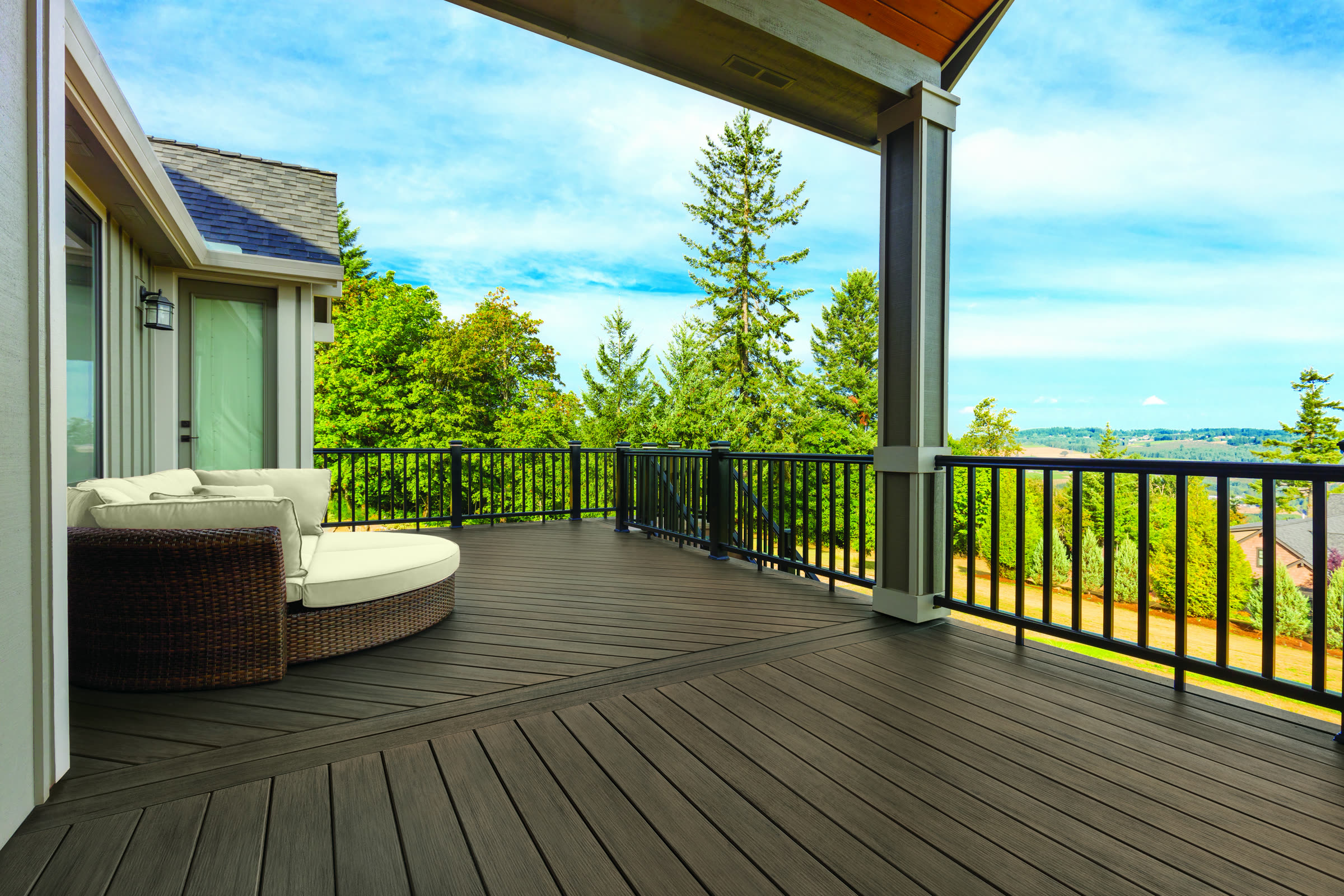
Composite decking needs far less maintenance than wood, but it is not zero-care. TimberTech boards require a basic wash 1-2 times per year — a 10-minute rinse in spring and a thorough scrub in fall. Keep the pressure washer below 3,100 kPa and maintain a 30-centimetre standoff. In Ontario, clearing debris from board gaps every autumn before the first freeze is the single most important task to prevent moisture trapping and mould growth in the subframe.
Composite decking is marketed as the set-it-and-forget-it upgrade from wood — and it is largely true. A TimberTech board installed in Barrie today will still be holding its colour in 2050 without a drop of stain or a single board replacement, assuming the framing underneath holds up. But in Ontario, where a single winter delivers 150 or more centimetres of snow and 30-plus freeze-thaw cycles between November and March, maintenance-free means far less maintenance than wood — not zero maintenance.
Most of the calls we get about composite deck problems — mould patches, spotty fading, boards that squeak or flex — trace back to a gap in the annual care routine. Not major lapses: leaves left in the board gaps from October to April, a pressure washer used at too high a setting, a bleach-based cleaner applied to a light-toned board three summers in a row. These are the things that turn a 30-year-warranty product into a headache.
This guide covers the actual maintenance schedule for composite decking in Ontario: what to do each spring and fall, how to run an annual structural inspection, and the warning signs to catch before they become expensive repairs.
How Often Does Composite Decking Actually Need Cleaning?
The honest answer is twice a year — once in spring after snowmelt, and once in late fall before freeze-up. On a typical 200- to 300-square-foot deck in Barrie or Innisfil, each cleaning takes 20 to 45 minutes with the right approach. If that sounds more frequent than expected from a low-maintenance product, consider the alternative: pressure-treated wood at the same size takes 6-12 hours of sanding, staining, and sealing every 2-3 years. Composite wins the comparison decisively.
Spring cleaning targets the winter's residue — salt from ice-melt products, organic debris compressed by snow, water staining from standing melt. Fall cleaning is more critical in Ontario because it removes the leaf litter, pollen, and organic grit that becomes mould substrate once temperatures drop below 4°C and the deck stops drying out between rains. If you are only going to do one cleaning per year, make it the fall one.
The right tool for both seasons is a garden hose with a medium-pressure nozzle and a stiff-bristle deck brush. TimberTech polymer-capped boards resist staining well, but debris that sits in the grooves and gap channels works into surface micro-abrasions over time. A scrub with water and a small amount of dish soap handles 90% of cleaning situations. If you use a pressure washer, stay at or below 3,100 kPa (450 psi) and maintain a minimum 30-centimetre standoff from the board surface. Fan-tip nozzles at a 40° spread are safer than zero-degree jets, which can score the capping layer.
For a detailed breakdown of how composite holds up compared to pressure-treated and cedar over an Ontario lifetime, see our TimberTech vs. wood decking comparison. If you are still deciding whether composite fits your budget, our online cost estimator gives you a ballpark range before we visit the site.
Spring Cleaning After an Ontario Winter: What Works and What Causes Damage
In April, after a Barrie winter that typically delivers 150-200 cm of snow and a freeze-thaw pattern that cycles 30 or more times, most composite decks emerge looking rough. Salt stains from calcium chloride ice-melt, dark water marks from standing snowmelt, and leaf-patterned stains compressed under the snowpack are all common. None of these cause structural damage to TimberTech capped composite boards, but some stains become harder to remove the longer they sit — and some cleaning methods cause more damage than the original stain.
Start with a sweep or leaf blower to remove loose debris, then rinse the entire surface with a garden hose, working perpendicular to the board direction so water pushes debris out of the gaps. For salt stains, a diluted white vinegar solution — 1 part vinegar to 4 parts water — applied with a brush and left for 5 minutes before rinsing handles most cases. For grease or barbecue residue, dish soap and warm water scrubbed with a medium-bristle brush works well. For rust marks from metal furniture legs, an oxalic acid-based deck wash is effective; Techniseal Bio-Cleaner is one product we have had consistent results with on jobs across Barrie and the surrounding townships.
What to avoid: bleach or chlorine-based cleaners as a routine product — they do not damage the composite core, but repeated use causes colour shift on lighter board tones such as Coastline and Silver Maple, and this is explicitly excluded under TimberTech warranty terms. Also avoid steel wool, metal scrapers, or abrasive scouring pads. Scratching the polymer cap layer exposes the composite core underneath, which is more porous and stains more easily from that point forward. For heavy mould growth after a wet winter, TimberTech Deck Cleaner is the safest option.
If you are uncertain about a product or need a professional to assess a stained section, our team handles this through our composite decking services in Barrie.
Fall Gap Clearance: The Single Most Important Task Before Ontario Winters
Of everything on the annual maintenance list, clearing debris from the board gaps each fall prevents the most expensive problems. Here is the mechanism: standard composite deck boards are installed with a 6 mm gap between them — the right amount for drainage and thermal expansion, but just wide enough for leaves, twigs, and grit to pack in over a Simcoe County autumn. Once that debris is wet and compressed, it holds moisture against the joist surface below. Through 30-plus freeze-thaw cycles, that trapped moisture accelerates mould growth, degrades joist surfaces, and in poorly-drained installations can cause significant rot in the pressure-treated framing within 8-10 years.
The tool for gap clearing is a putty knife, a thin-bladed weeding tool, or a dedicated decking gap brush. Work in straight runs along each gap channel. On a 280-square-foot deck with standard 140mm boards and 6mm gaps, plan for 25-35 minutes to clear all the runs. It is repetitive work, but it is the difference between a subframe that lasts 25 years and one that needs partial replacement in 15.
While you are at gap level, look into the joist bays. A key warning sign: standing water or debris compacted on the joist top surfaces. Joists should shed water freely; if they are holding it, the spacing between the deck surface and the top of the joists may be too tight, or the ledger flashing may be directing water inward rather than out. A 30-minute visual inspection each fall — flashlight into the joist bays, screwdriver probe at the ledger board — catches these issues when they are a $300-$600 flashing repair rather than a $6,000-$12,000 structural rebuild.
After gap clearing, rinse the deck surface to wash any disturbed organic material off the boards and out through the gaps. Then stow or cover furniture that is not rated for Ontario winters. Furniture legs resting on the same spot through 5-6 months of freeze-thaw can leave minor impressions — less of an issue with TimberTech PrimeCollection and AZEK Vintage boards than with entry-level products.
What Actually Voids a TimberTech Composite Deck Warranty in Ontario
TimberTech residential warranty on capped composite products covers fade and stain resistance for 30 years and structural defects for 25 years. That is genuinely strong coverage, but it carries specific installation and maintenance conditions that most homeowners only read after something goes wrong. The four most common warranty voiders we see on existing decks:
- Routine bleach or chlorine use. TimberTech documentation allows bleach for occasional spot treatment only, not as a regular cleaner. Repeated use causes colour change in lighter board tones and is a documented exclusion from fade warranty coverage.
- Unprotected cut ends. When you mitre a board or cut a custom length, you expose the composite core at the cut face. That core is more moisture-absorbent than the capped surface. Sealing cut ends with a colour-matched end cut sealant is required under the warranty terms. We do this on every trim cut we make — it adds a minute per cut but matters for the 25-year window.
- Inadequate ventilation under the deck. TimberTech specifies a minimum 25 mm clearance between the underside of the deck surface and any solid obstruction below. Decks built flush to the ground without ventilation channels can void coverage. In Ontario, where decks are often low to grade on concrete pads, this is worth verifying.
- Joist spacing outside product specification. Depending on the board line, TimberTech specifies joist spacing of 300-400 mm on-centre. Exceeding the maximum spacing — for example, 600 mm centres left over from an older wood deck frame — produces deflection that is both noticeable underfoot and a warranty exclusion. Reach out through our contact page if you are unsure whether an existing framing layout meets the current specification.
Checking the Subframe and Fasteners: What Ages Under the Boards
Here is the counterintuitive reality about composite decking longevity: the boards themselves will almost always outlast the problems that need managing. TimberTech polymer-capped boards are engineered to handle UV, moisture cycles, and Ontario freeze-thaw for 25-30 years. What ages faster, in most installations, is the pressure-treated subframe underneath — the joists, beams, ledger board, and post connections. A composite deck that looks perfect on the surface can be sitting on framing that is in early-stage failure.
Pressure-treated lumber used for deck framing in Ontario is typically ACQ or MCA treated — effective at resisting rot and insects, but not indefinite. In a well-built installation with proper drainage, PT joists last 20-30 years. In a poorly-drained installation where water pools at the ledger or where joist bays do not ventilate, significant rot can develop in 8-10 years. We have done composite board inspections on decks where the homeowner assumed a board problem and discovered the joists were the actual issue.
Add these to your annual inspection routine:
- Probe the ledger board with a screwdriver at several points. Sound wood resists the probe firmly. Wood that the tip sinks into easily indicates early-stage rot — schedule a repair before it spreads.
- Check joist ends at the perimeter beam. Cut ends are the most moisture-vulnerable points on any PT joist. Look for blackening, soft spots, or fungal growth along the beam face.
- Inspect post bases. Concrete pier posts with adjustable steel bases are standard in our installations. Surface rust on the base plate is normal; deep pitting that eats into the connector flange or the anchor bolt means the hardware needs replacement before the next freeze season.
- Verify fastener condition. We spec 305-grade stainless fasteners on all composite installs. If your deck uses galvanised screws, check for rust streaking on the board surface near fastener locations — that is a sign of corrosion working through the fastener shaft.
For a full framing inspection or a quote on a new TimberTech installation, start with our online cost estimator and we will follow up with a site visit.
Annual maintenance: TimberTech composite vs. pressure-treated wood
| Task | TimberTech Composite | Pressure-Treated Wood |
|---|---|---|
| Cleaning frequency | 2× per year (rinse + scrub) | 2-3× per year (scrubbing required) |
| Staining or sealing | Not required | Every 2-3 years |
| Sanding or splinter removal | Not required | Annual light sanding recommended |
| Fall gap debris clearing | Required annually | Required annually |
| Subframe inspection | Annual (joists, ledger, post bases) | Annual (joists, ledger, post bases) |
| Board replacement frequency | Rare — 25-30 yr boards | Every 5-10 years in high-traffic zones |
| Estimated annual maintenance time | 1-3 hours | 8-16 hours (stain years) / 3-5 hours (off years) |
Frequently Asked Questions
How often should I clean composite decking in Ontario?
Twice a year — once in spring after snowmelt to clear salt residue and water staining, and once in early fall before the first freeze to remove leaf litter and organic debris from the board gaps. The fall cleaning is more important in Ontario because organic material left in the gaps through freeze-thaw cycles creates ideal conditions for mould and accelerates deterioration of the framing underneath. Each cleaning takes 20-45 minutes on a typical 200-300 square-foot deck.
Can I use a pressure washer on composite decking?
Yes, with limits. Stay at or below 3,100 kPa (450 psi) and maintain a minimum 30-centimetre standoff from the board surface. Use a fan-tip nozzle at a 40° spread, not a zero-degree jet. High-pressure washing at close range or with a narrow tip can damage the polymer capping layer on TimberTech boards, exposing the composite core and making that spot stain more easily. A garden hose with a stiff brush handles most routine cleaning without any risk.
How do I remove mould from composite decking boards?
For light mould growth, dish soap and warm water scrubbed with a stiff-bristle brush and rinsed thoroughly works well. For heavier mould, TimberTech Deck Cleaner or an oxalic acid-based deck wash such as Techniseal Bio-Cleaner handles most cases without damaging the board surface. Avoid bleach-based cleaners for routine mould treatment — repeated bleach use causes colour shift on lighter-toned boards such as Coastline and Silver Maple, and may affect warranty coverage on the fade claim.
Does composite decking need to be sealed or stained?
No. Capped composite boards like TimberTech PrimeCollection have a polymer outer layer that replaces the function of stain and sealant. Applying deck stain or sealant to a composite board is not only unnecessary — it can interfere with the surface and void warranty coverage. The boards are engineered to hold their colour and shed moisture without any topical treatment, which is the main advantage over pressure-treated or cedar wood.
What is the biggest maintenance mistake Ontario homeowners make with composite decking?
Leaving leaves and organic debris in the board gaps through the winter. Ontario freeze-thaw cycles — typically 30 or more between November and March — compact wet debris against the joist surfaces underneath, holding moisture where it accelerates mould and rot in the pressure-treated framing. A 25-35 minute gap clearing session each October or early November prevents what can eventually become thousands of dollars in subframe repair. It is also the most commonly skipped step because the deck surface looks fine while the problem builds underneath.
How long does composite decking last in Ontario's climate?
TimberTech capped composite boards (PrimeCollection) carry a 25-year structural warranty and a 30-year fade and stain warranty for residential installations. AZEK Vintage — a different, fully-PVC TimberTech line — carries its own 50-year fade and stain warranty. In practice, we expect properly installed boards on either line to perform for 30 or more years. The subframe — pressure-treated joists, ledger, and beam — typically lasts 20-30 years in well-drained installations. The limiting factor in most Ontario composite deck lifespans is framing deterioration, not board failure, which is why annual subframe inspection matters.
What joist spacing is required for TimberTech composite decking?
TimberTech specifies joist spacing of 300-400 mm on-centre, depending on the board product line and the installation angle. Boards installed at a 45° angle to the joists require tighter joist spacing than boards installed perpendicular. Exceeding the maximum joist spacing causes noticeable deflection underfoot and voids the structural warranty. If you are building on an existing wood deck frame with 600 mm centres, the frame needs to be updated before TimberTech boards are installed.

Yorkis Estevez founded Golden Maple Landscaping in Barrie in 2020. Since then, we have installed TimberTech composite decking across Simcoe County — Barrie, Innisfil, Oro-Medonte, Springwater, and beyond. We are WSIB certified, carry $5M in liability coverage, and hold a 5.0 Google rating. The maintenance guidance in this article comes directly from what we have seen go wrong — and right — on dozens of decks over six Ontario seasons.
If you have questions about your existing composite deck — a cleaning concern, a structural inspection, or a warranty question — we are based in Barrie and serve all of Simcoe County. We also install new TimberTech decks from design through permit to final walkthrough. Reach out through our contact page and we will respond within one business day.