
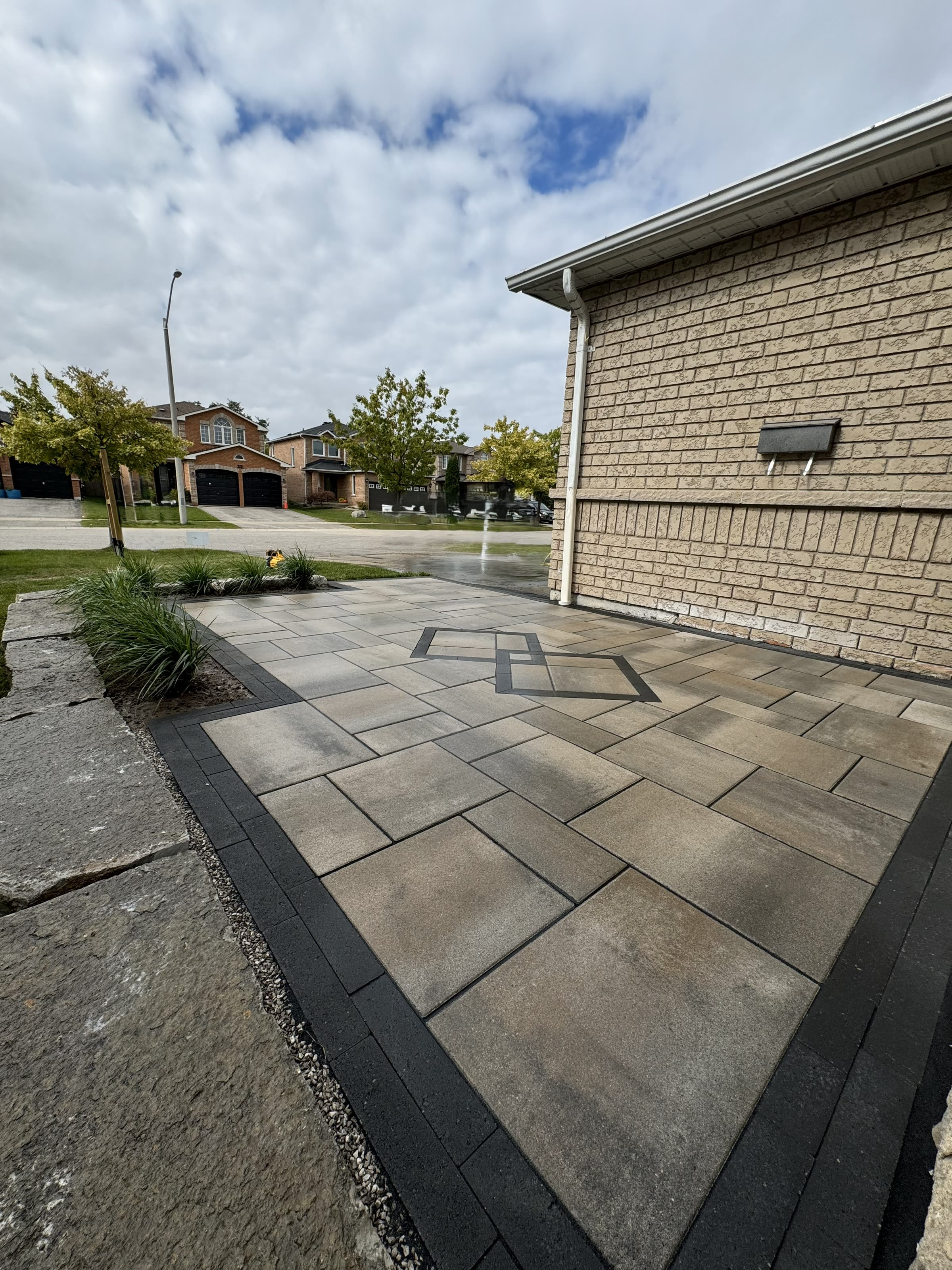
You spent $15,000 on a new patio last summer. It looked incredible — for about eight months. Then winter arrived, and by April, your stones were uneven, your edges were lifting, and there was a puddle where water used to drain. Sound familiar?
You're not alone. This is the single most common complaint we hear from homeowners in Barrie and across Simcoe County. And the frustrating part? It was 100% preventable.
The Real Reason Your Patio is Sinking
It's not the pavers. It's not the sand. It's not even the weather — although Barrie's freeze-thaw cycle is brutal. The reason your patio is sinking is because your contractor didn't dig deep enough.
Most contractors in the Barrie area dig a base of 6 to 8 inches. They lay down some gravel, compact it a couple of times, and call it done. This is the industry minimum — and in Simcoe County's clay-heavy soil with its extreme temperature swings, the industry minimum is a recipe for failure.
What Happens Underground
When water gets under your patio base — and it will — it freezes. Frozen water expands. This is called frost heave, and it pushes your carefully laid stones upward. When the ice melts, your stones settle back down — but never quite to where they were. Multiply this by dozens of freeze-thaw cycles per winter, and you've got a patio that looks like a roller coaster.
The 12-16 Inch Solution
At Golden Maple, we dig our bases to 12 to 16 inches deep — roughly double the industry standard. Here's what that actually looks like:
- Excavation: We remove all organic material and unstable soil down to virgin ground.
- Geotextile fabric: A separation layer that prevents clay from migrating up into your base.
- Clear stone base: Structural-grade ¾" clear stone that drains instantly — water can't pool in it, so it can't freeze and push your pavers.
- Compaction in lifts: We compact every 3-4 inches, not all at once. This creates a base that behaves like a monolithic slab.
- Bedding layer: A final layer of high-performance bedding sand for precision leveling.
Why Most Contractors Don't Do This
Honestly? Because it takes longer and costs more. Digging 16 inches means more excavation, more material, more compaction passes, and more labour hours. A contractor working on a tight margin will skip this because they know it'll look fine for the first year — and by the time your patio starts sinking, they'll be long gone.
"The base is the one thing you can never fix after the fact. If it's not right from day one, your only option is to tear everything up and start over."
How to Tell if Your Current Patio Has a Problem
Watch for these early warning signs:
- Water pooling in areas that used to drain properly.
- Uneven stones — even slight lippage of 2-3mm indicates movement.
- Widening joints — when polymeric sand gaps appear, your stones are spreading apart.
- Edge creep — the perimeter of your patio is slowly pushing outward.
What We'd Tell Any Homeowner in Barrie
When you're getting quotes for a patio project, ask one question: "How deep will you dig the base?" If the answer is anything less than 12 inches, keep looking. The money you save upfront will cost you double when you're re-doing the project in three years.
At Golden Maple, we back our base work with a 5-year sink and settlement warranty. We've never had to honour a claim — because when you build it right, it stays right. That's not marketing. That's engineering.