
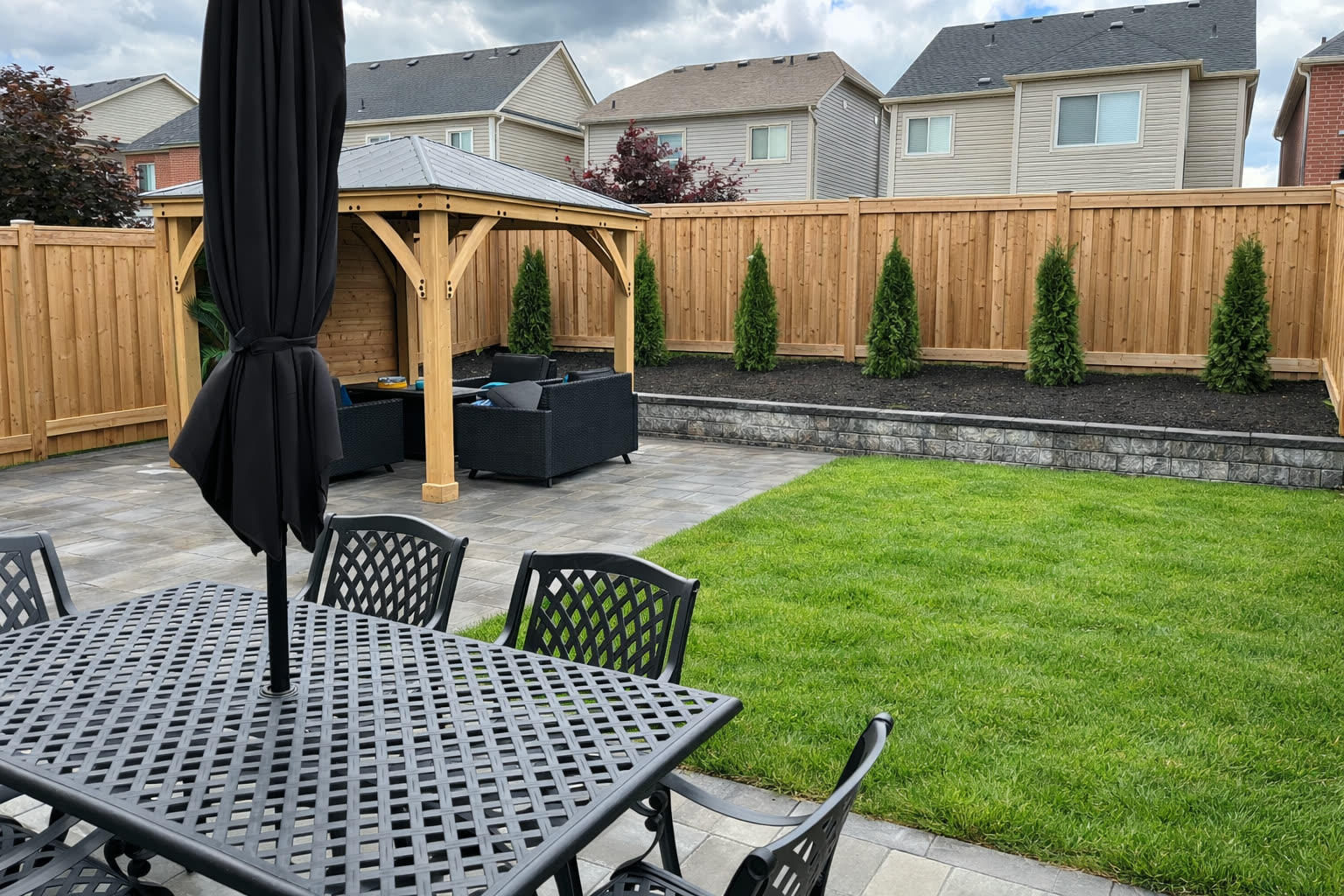
A failing interlocking patio in Barrie shows six early signs: joints wider than 1/4 inch, pavers sinking more than 1/2 inch, edge restraints pulling away from the perimeter, standing water 24+ hours after rain, weeds pushing through joints, and visible spring heave. Catching these in year 2-4 usually costs $800-$2,500 for a localized fix with a proper 12-16 inch compacted clear stone base. Waiting until year 6-8 often means a $12,000-$20,000 full rebuild.
I've pulled up more failing patios in Barrie than I can count, and almost every one starts the same way: a homeowner notices a paver wobble underfoot near the patio door, decides it's probably nothing, and calls two summers later once half the surface has heaved after a rough winter.
Simcoe County isn't kind to hardscaping. Barrie's clay-heavy soil holds water like a sponge, and we typically count 60-85 freeze-thaw cycles between November and April. If a patio was installed on a thin granular A base instead of a properly compacted 12-16 inch clear stone base, that cycle works the joints loose year after year until the whole system fails at once — not gradually.
The good news is that a failing patio gives you warning signs for 1-3 years before it turns into a full rebuild. Here's exactly what to look for, roughly in the order each sign tends to show up.
Why Are My Pavers Sinking or Uneven?
Sinking or uneven pavers are the earliest visible sign of base failure, and they show up first in high-traffic zones — patio doors, fire pit edges, and the path between a deck and the yard.
The root cause is almost always the base, not the pavers themselves. A properly built interlocking patio sits on 12-16 inches of compacted clear stone, which drains water and resists frost heave. Installers cutting corners use 6-8 inches of granular A instead, which holds moisture and pumps upward every time Barrie's clay subgrade freezes. A healthy patio's surface should hold under 1/4 inch of variance across any 10-foot span — if you can rock a paver with your foot or see a dip deeper than 1/2 inch, the base underneath has already voided out.
Tree roots are the other common culprit, especially on older lots near Bayfield Street and downtown Barrie with mature maples. A root growing under one corner of a patio will lift that section 1-2 inches over 2-3 seasons while the rest stays flat, creating a trip hazard long before it looks dramatic.
If you're seeing this on a patio installed within the last 3-5 years, it's worth reading why patios sink in Barrie's soil conditions before deciding on a fix — the right repair depends on whether it's a base problem or a root problem.
What Does Spring Heave Look Like on an Interlocking Patio?
Spring heave is what happens when frozen water trapped in the base thaws unevenly, and it shows up as a section of patio that's noticeably higher or tilted compared to the rest of the surface for a few weeks each spring — usually late March into April in Barrie.
Unlike gradual sinking, heave is seasonal: water that worked its way into base voids over the winter freezes and expands roughly 9% in volume, physically lifting the pavers above it. Where the base is compacted properly, that expansion has nowhere to go and the surface stays flat. Where the base has voided out — from an undersized granular A layer or water pooling against it — the lift concentrates in that one soft spot instead of spreading evenly, and you get a hump or a section that visibly rocks when you step on it.
A patio that heaves in the same spot every spring and settles back down by June still has a live base problem, even though it appears to fix itself seasonally — the freeze-thaw cycle wears that spot down a little further each year, and it's usually the first sign of the localized sinking that shows up permanently a year or two later. Catching it at the seasonal-heave stage, before it stops settling back down, is when a $800-$1,500 spot repair is still on the table instead of a full section rebuild.
What Do Widening Joints Between Pavers Mean?
Widening joints mean the polymeric sand locking your pavers together is washing out, and it's usually the first thing homeowners notice because it changes how the patio feels underfoot.
ICPI (Interlocking Concrete Pavement Institute) specs call for joints between 1/8 and 3/16 inch, packed tight with polymeric sand that hardens once activated with water. When that sand erodes — from repeated freeze-thaw, aggressive pressure washing, or poor initial compaction — joints open to 1/4 inch or wider and pavers start shifting laterally instead of locking together as one surface.
Once joints exceed roughly 3/8 inch, you're past a simple re-sand. At that width, individual pavers can rock independently, which accelerates edge chipping and lets more water into the base — the two failures compound each other. We see this most on patios that are 6-10 years old and were never re-sanded on any schedule; polymeric sand has a functional life of about 5-7 years in this climate before it needs topping up.
Weeds pushing up through those same open joints are common enough to warrant their own look — see below.
Why Are Weeds Growing Through My Patio Joints?
Weeds pushing up through the joints between your pavers aren't a landscaping nuisance on their own — they're confirmation that the polymeric sand locking your patio together has already washed out below grade, the same failure driving the joint-widening above.
Polymeric sand is engineered to harden into a solid, weed-resistant layer once activated with water. Once enough of it erodes — from freeze-thaw cycling, aggressive pressure washing, or sand that was never fully activated at installation — the joint underneath opens up into loose, organic-rich material that seeds can actually root in. If you're pulling the same weeds from the same joints every summer despite regular maintenance, that's the tell: it's not a one-off, the sand is gone from that section.
Weeds by themselves are a $200-$400 re-sand fix if caught early — lift the growth, clean the joint, refill with fresh polymeric sand. Left alone, the open joint keeps letting water into the base every time it rains, which is what turns a cosmetic weed problem into the sinking or edge-spread failures covered elsewhere on this page.
Why Is My Patio Edge Pulling Away From the Lawn?
A gap opening between your patio's outer edge and the surrounding lawn or garden bed means the edge restraint has failed — one of the fastest-moving failures on this list because it removes the confinement the whole system depends on.
Interlocking pavers only stay locked together because something is holding the perimeter in place, typically a plastic or aluminum restraint spiked into the base every 12 inches. Plastic restraints, common on budget installations, degrade under UV exposure and winter road salt within 5-7 years, letting spikes back out of the ground. Once even one 3-4 foot section fails, pavers along that edge start creeping outward, typically 1/4 to 1/2 inch per freeze-thaw season.
Within 2-3 years of the first edge failure, that creep telegraphs inward — you'll see gaps opening between interior pavers 3-6 feet from the edge, not just at the perimeter. This is a case where a $500-$1,200 fix now (excavating the edge, installing aluminum restraint, re-compacting the last 18 inches of base) prevents the $12,000+ rebuild that follows once interior joints have opened up too.
If your patio is under 5 years old and already showing perimeter gaps, that points to a restraint that was under-spiked or spaced too far apart at installation — a build-quality issue, not just wear.
Why Is Water Pooling on My Patio After Rain?
Standing water anywhere on your patio more than 24 hours after rain means the slope has failed — and it's the sign most likely to turn into structural damage rather than just cosmetic wear.
A correctly graded interlocking patio slopes 1-2% away from the house, roughly 1/4 inch of drop per foot. That slope matters more in Barrie than in most of Ontario because our clay subgrade barely percolates water; where sandier soils absorb standing water in a few hours, clay can hold it against the paver base for a full day or more, especially in low spots when Lake Simcoe's water table rises in spring.
Trapped water under pavers is what turns a cosmetic issue into a structural one: water that can't drain freezes in the base voids, expands roughly 9% in volume, and physically pries pavers apart from underneath. One freeze-thaw cycle does almost nothing; the 60-85 cycles a typical Simcoe County winter delivers is what cracks pavers and heaves whole sections.
Pooling directly against the house foundation needs the fastest attention — it's a drainage problem for the house, not just the patio, and can contribute to basement moisture separate from the paver damage itself. Regrading a pooling section typically runs $1,500-$4,000 depending on how much base has to come out to fix the slope.
Should You Repair a Failing Patio or Rebuild It?
Short answer: repair if less than 15-20% of the surface shows damage and the base underneath is still intact; rebuild if the base has voided out under a larger area, or if you've got more than one failure mode happening at once — sinking plus edge spread plus pooling, for example.
A localized repair — lifting 3-8 pavers, adding compacted clear stone to bring the base back to proper depth, and resetting with fresh polymeric sand — typically runs $800-$2,500 in the Barrie area depending on access and how much base material has to come in from a supplier like Carr Landscape Depot. That fix should hold another 8-10 years if the underlying cause, usually a root or a soft spot, is actually addressed rather than just patched over.
A full rebuild on a typical 350-450 square foot patio runs $12,000-$20,000 once you're excavating down to subgrade, installing a proper 12-16 inch compacted clear stone base, and resetting with ICPI-rated 80mm pavers — Permacon, Unilock, or Techo-Bloc depending on the look you want. That range moves based on drainage work, retaining involved, and paver selection.
The number that actually decides which path makes sense is how much base is compromised, not how bad the surface looks. A patio that looks rough but sits on a solid base is a repair; a patio that looks fine but has 30%+ base failure underneath is a rebuild waiting to happen — not something you can eyeball from the surface, which is why we walk every patio before quoting either direction. Get a ballpark with our cost estimator, or read through our interlocking patio installation process if you're leaning toward a full rebuild.
Failing patio signs in Barrie, ranked by severity and typical repair cost
| Sign | Likely Cause | Recommended Fix | Typical Cost (CAD) |
|---|---|---|---|
| Seasonal spring heave (settles back by summer) | Frozen water trapped in a base void | Spot-repair the soft area before it stops settling | $800-$1,500 |
| Joint gaps under 1/4 inch | Polymeric sand washout | Re-sand with fresh polymeric sand | $300-$600 |
| Weeds growing through joints | Polymeric sand washed out | Clean the joint and re-sand | $200-$400 |
| Localized sinking (1-8 pavers) | Base settling or a tree root | Lift and relevel the section | $800-$1,500 |
| Edge spreading at the perimeter | Failed plastic edge restraint | Replace with aluminum restraint | $500-$1,200 |
| Standing water 24+ hours after rain | Wrong slope or clay subgrade | Regrade and correct drainage | $1,500-$4,000 |
| Widespread sinking (over 20% of area) | Undersized granular A base | Excavate and rebuild the base | $12,000-$20,000 (350-450 sq ft) |
Frequently Asked Questions
How do I know if my interlocking patio needs to be replaced instead of repaired?
If more than 15-20% of the surface shows sinking, cracking, or edge spread — or if two or more failure types are happening at once — you're likely looking at a rebuild rather than a repair. A patio with an intact base and isolated damage under 8-10 pavers is almost always repairable for $800-$2,500.
What causes interlocking pavers to sink in Barrie?
The most common cause is an undersized base — 6-8 inches of granular A instead of the 12-16 inches of compacted clear stone needed to resist Simcoe County's 60-85 annual freeze-thaw cycles. Tree roots and poor initial compaction are the other two leading causes.
How much does it cost to fix a sinking patio in Ontario?
A localized lift-and-relevel repair typically costs $800-$2,500 in the Barrie area, while a full rebuild of a 350-450 square foot patio with a proper compacted base runs $12,000-$20,000. The difference comes down to how much of the base underneath is actually compromised.
Can a sinking patio be repaired without tearing out the whole thing?
Yes, if the sinking is limited to one section and the surrounding base is still compacted and dry. Crews lift the affected pavers, rebuild the base underneath to proper depth, and reset with fresh polymeric sand — a fix that holds for 8-10 years when the root cause is actually addressed.
How long should an interlocking patio last in Simcoe County?
A patio built on a proper 12-16 inch compacted clear stone base with ICPI-rated 80mm pavers should perform well for 20-25 years with re-sanding every 5-7 years. Patios built on thinner granular A bases often show base failure within 8-12 years.
What is the right base depth for pavers in Barrie's climate?
12-16 inches of compacted clear stone is the base depth needed to handle Barrie's clay soil and freeze-thaw cycles, deeper than the 6-8 inches sometimes used in warmer, sandier regions. Skimping on base depth is the single biggest predictor of early patio failure we see.
Does the City of Barrie require a permit to repair or rebuild a patio?
A ground-level interlocking patio repair or rebuild generally doesn't require a building permit in Barrie, but any patio tied to retaining walls over 1 metre, structural changes near a property line, or drainage changes affecting neighbouring lots should be confirmed against current City of Barrie bylaws before work starts.

I\'m Yorkis Estevez, founder of Golden Maple Landscaping. We\'ve built our interlocking work around one non-negotiable: a 12-16 inch compacted clear stone base, every time, sourced through Carr Landscape Depot here in Barrie. We\'re WSIB certified, carry $5M in liability coverage, and hold a 5.0 rating on Google — because the base you can\'t see is what actually decides whether a patio lasts.
If you're seeing any of these signs on your own patio — whether you're in Barrie, Innisfil, Orillia, or elsewhere in Simcoe County — the earlier we take a look, the more likely it's a $1,000 repair instead of a $15,000 rebuild. Reach out and we'll walk the patio with you, give it to you straight, and back any work with the same 12-16 inch clear stone base standard we build every job on.