
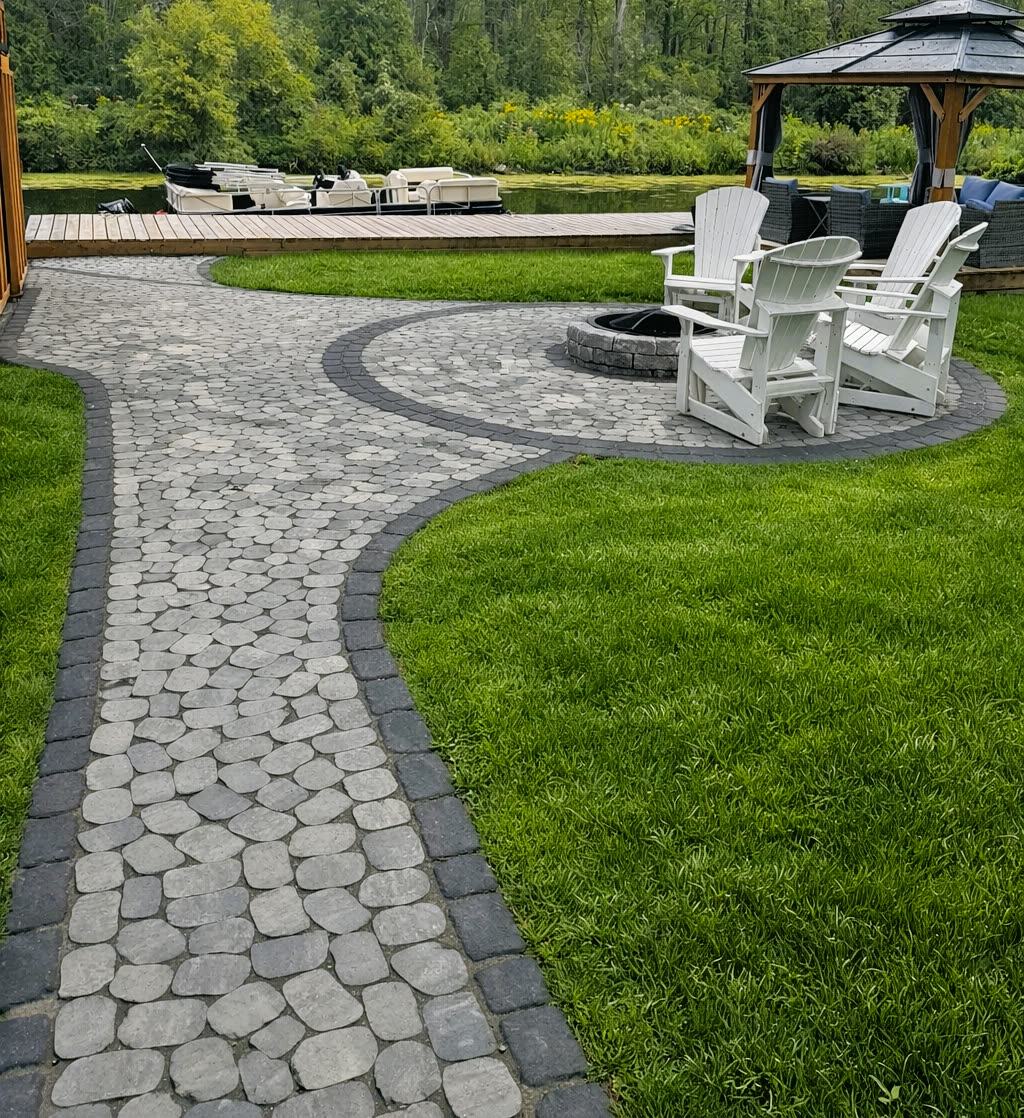
For most Barrie homeowners, concrete pavers (Unilock, Techo-Bloc, Permacon) are the more practical choice: they cost $18-$32 per square foot installed, flex with our freeze-thaw cycles, and any damaged unit is replaceable in minutes. Natural stone runs $30-$55+ per square foot and delivers a one-of-a-kind look, but it\'s less forgiving of ground movement and harder to repair. Choose pavers for value and resilience; choose natural stone when a signature, high-end aesthetic justifies the premium and the maintenance.
It's one of the first real decisions every Barrie homeowner faces once a patio or walkway project gets serious: natural stone or concrete pavers? Both look fantastic in a showroom. Both will cost you real money. And both will be sitting in your backyard through twenty-plus Simcoe County winters, so the choice matters a lot more than the brochure photos suggest.
After installing hundreds of patios, walkways, and driveways across Barrie, Innisfil, and Oro-Medonte, we've seen how each material actually behaves once the freeze-thaw cycles, clay soil, and snow-removal season get to work on it. This guide skips the marketing and walks you through the honest trade-offs — cost, durability, installation, maintenance, and the 20-year cost of ownership — so you can pick the surface that fits your home, your budget, and your tolerance for upkeep.
What 'Natural Stone' and 'Pavers' Actually Mean
The two categories get lumped together as "hardscaping," but they're fundamentally different products. Natural stone is quarried rock — flagstone, granite, limestone, sandstone, or porcelain-clad stone — cut or split into slabs and pieces. Every piece is unique, with natural colour variation and texture you simply can't fake. In Barrie, full-bed flagstone and natural granite are the most common premium picks.
Concrete pavers are manufactured units, pressure-formed from concrete and pigment to precise dimensions. The leading brands homeowners ask us about — Unilock, Techo-Bloc, and Permacon — engineer their products specifically for the Canadian freeze-thaw climate. If you're weighing those three, we wrote a detailed comparison in our Unilock vs. Techo-Bloc vs. Permacon guide.
The practical upshot: pavers give you consistency, predictable pricing, and engineered performance. Natural stone gives you character and prestige, but with more variability in thickness, more cutting and fitting labour, and a higher material cost. Both can be stunning — they just get there differently.
How Each Handles Barrie's Freeze-Thaw Reality
Barrie sits in one of Ontario's harsher freeze-thaw zones. We routinely see 40 to 60 freeze-thaw cycles in a single season — water seeps into the surface and base, freezes, expands roughly 9%, and pushes everything around. Over years, that movement is what cracks, heaves, and lifts a poorly built patio. This is the single biggest factor in our climate, and it's covered in depth in our breakdown of why patios sink in Barrie.
Concrete pavers handle this well because they're a flexible system: dozens or hundreds of individual units sit on a compacted aggregate base with sand-filled joints. When the ground moves, the units shift together and settle back, rather than fracturing. Quality pavers are rated to absorb very little water (low absorption, typically under 5%), which limits internal freeze damage.
Natural stone's performance depends heavily on the type. Dense stones like granite and quality porcelain shrug off freeze-thaw beautifully. Softer, more porous stones like some sandstones and limestones can absorb water, then spall or flake after repeated freezes if they aren't sealed and installed correctly. Thickness also matters — irregular natural slabs put more demand on a flawless base. Done right, natural stone lasts generations; done on a weak base, it telegraphs every bit of ground movement.
Cost Breakdown: What You'll Actually Pay in Simcoe County (2026)
Here are real installed-price ranges we're quoting in the Barrie area in 2026 — material, base, and labour included, not just the stone off the pallet.
Concrete pavers: roughly $18 to $32 per square foot installed for standard residential work. Premium textured or large-format lines (Techo-Bloc Blu, Unilock Umbriano) push the top end. A typical 400 sq ft paver patio lands somewhere around $9,000 to $13,000 depending on access, base depth, and pattern complexity.
Natural stone: roughly $30 to $55+ per square foot installed. Full-bed flagstone set in a mortar bed or on a deep aggregate base sits at the higher end because of the cutting, fitting, and extra labour each irregular piece demands. That same 400 sq ft patio in natural stone can run $14,000 to $22,000 or more.
The gap is real — natural stone commonly costs 40% to 70% more installed. But raw price-per-foot is only half the story. What you pay over the next two decades depends just as much on installation quality and repair cost, which is where the comparison gets interesting.
Installation and Base: Where the Money (and the Failures) Live
Whichever material you choose, the part you never see — the base — determines whether your patio still looks new in 15 years. In Barrie's clay-heavy soil, we excavate and build a compacted granular base, typically 6 to 12 inches deep depending on the application (more for driveways that carry vehicle loads). That base, properly compacted in lifts, is what resists frost heave.
Pavers go down on a screeded bedding layer with tight, consistent joints stabilized by polymeric sand. Because units are uniform, installation is faster and more repeatable, which keeps labour predictable. Our full process for paver and interlocking work is outlined on our interlocking services page.
Natural stone is more labour-intensive: irregular slabs have to be sorted, cut, and dry-fit like a puzzle, and variable thickness means each piece is set individually to a level plane. That craftsmanship is exactly why natural stone looks the way it does — but it adds hours, and it's why a stone installer's skill matters even more than with pavers. A beautiful stone on a rushed base is a guaranteed callback. This is the number-one reason we tell homeowners to vet the installer harder than the material.
Maintenance, Repairs, and the 20-Year Cost of Ownership
This is where pavers quietly win for most homeowners. If a paver cracks, stains, or settles, you lift the affected units and swap them — a 20-minute fix that's nearly invisible because the replacements match. Joint sand gets refreshed every few years, and an occasional rinse keeps things looking sharp. Manufacturers like Techo-Bloc back many lines with transferable lifetime structural warranties, and a well-built paver patio commonly performs for 25 to 30 years.
Natural stone repairs are harder. Because each piece is unique, matching a cracked or spalled stone years later can mean hunting down a similar quarry batch — and a mortar-set installation can require breaking out and re-bedding sections. Sealing every 2 to 3 years is also recommended for porous stone to fight staining and freeze damage, which is a recurring cost and chore pavers largely avoid.
The honest math: natural stone's higher upfront cost plus periodic sealing and tougher repairs usually keeps it more expensive over 20 years. But if a stone patio is installed correctly on dense material, it can outlive everything around it and become a genuine selling feature. You're paying a premium for character and longevity — just go in knowing the upkeep is real.
Which Should You Choose? An Honest Recommendation
For the majority of Barrie and Simcoe County homeowners, concrete pavers are the smarter buy. They deliver excellent durability in our climate, the widest range of looks at every budget, predictable pricing, and repairs that don't make you wince. If you want strong value, low hassle, and a patio that handles snow-removal season without drama, pavers are hard to beat.
Choose natural stone when the aesthetic is the point. If you're building a signature outdoor living space, a high-end property where a one-of-a-kind flagstone terrace fits the architecture, and you've budgeted for both the premium and the maintenance — natural stone is unmatched. It reads as luxury because it is, and on the right project it's worth every dollar.
A middle path we often recommend: use pavers for the large functional areas (the main patio, walkways, driveway) and reserve natural stone for a feature — a fireplace surround, a set of steps, or a focal seating area. You get the prestige where it shows most and the value everywhere else. There's no universally "right" answer here — only the right answer for your home, your soil, and how you actually want to spend the next 20 years using the space.
Natural Stone vs. Concrete Pavers — Barrie Buyer's Comparison
| Factor | Concrete Pavers | Natural Stone |
|---|---|---|
| Installed cost / sq ft | $18-$32 | $30-$55+ |
| Typical lifespan | 25-30 years | 30+ years (if dense + well set) |
| Freeze-thaw resilience | High (flexible system) | Varies (high for granite/porcelain) |
| Repairability | Easy — swap individual units | Difficult — matching + re-bedding |
| Maintenance | Low — joint sand, occasional rinse | Moderate — seal every 2-3 yrs |
| Look | Consistent, engineered, huge range | Unique, premium, natural variation |
| Best for | Value, durability, low hassle | Signature high-end aesthetics |
Frequently Asked Questions
Is natural stone or pavers better for Barrie's climate?
Concrete pavers are generally the more reliable choice for Barrie's freeze-thaw climate because their flexible, segmented design moves with ground shifts instead of cracking. Dense natural stone like granite also performs very well, but softer, porous stones can spall over time if not sealed and installed on a proper base.
How much more expensive is natural stone than pavers?
In the Barrie area in 2026, natural stone typically costs 40% to 70% more installed than concrete pavers. Pavers run about $18-$32 per square foot installed, while natural stone runs roughly $30-$55+ per square foot depending on the stone type and installation method.
Which lasts longer, pavers or natural stone?
A well-built concrete paver patio commonly lasts 25-30 years, and many premium lines carry transferable lifetime structural warranties. Dense natural stone set on a proper base can last 30 years or more. In both cases, the base and installation quality matter more than the material itself.
Are pavers easier to repair than natural stone?
Yes. If a paver is damaged or stained, you simply lift it and drop in a matching replacement in minutes. Natural stone repairs are harder because each piece is unique and a mortar-set installation may require breaking out and re-bedding a section to fix it.
Does natural stone need to be sealed in Ontario?
Porous natural stones like sandstone and some limestones should be sealed every 2 to 3 years to resist staining and freeze-thaw damage in Ontario's climate. Dense stones like granite and porcelain need less sealing. Concrete pavers generally don't require sealing, though it's optional for stain protection.
Can I combine natural stone and pavers in one project?
Absolutely, and it's one of our most popular recommendations. Using pavers for large functional areas and natural stone for a feature like steps, a fireplace surround, or a focal seating area gives you a premium look where it shows most while keeping the overall budget and maintenance reasonable.

Yorkis Estevez, founder of Golden Maple Landscaping, has been transforming outdoor spaces across Barrie and Simcoe County since 2020. With hundreds of patios, walkways, and driveways installed, WSIB certification, and $5M liability coverage, Yorkis backs every Golden Maple project with a 5-year structural warranty and a perfect 5.0 Google rating.
Still deciding between natural stone and pavers for your Barrie project? Golden Maple Landscaping will help you choose the right surface for your home, soil, and budget — no pressure, just honest advice. Contact us today to book a consultation, browse our portfolio for inspiration, or run the numbers with our cost estimator.