
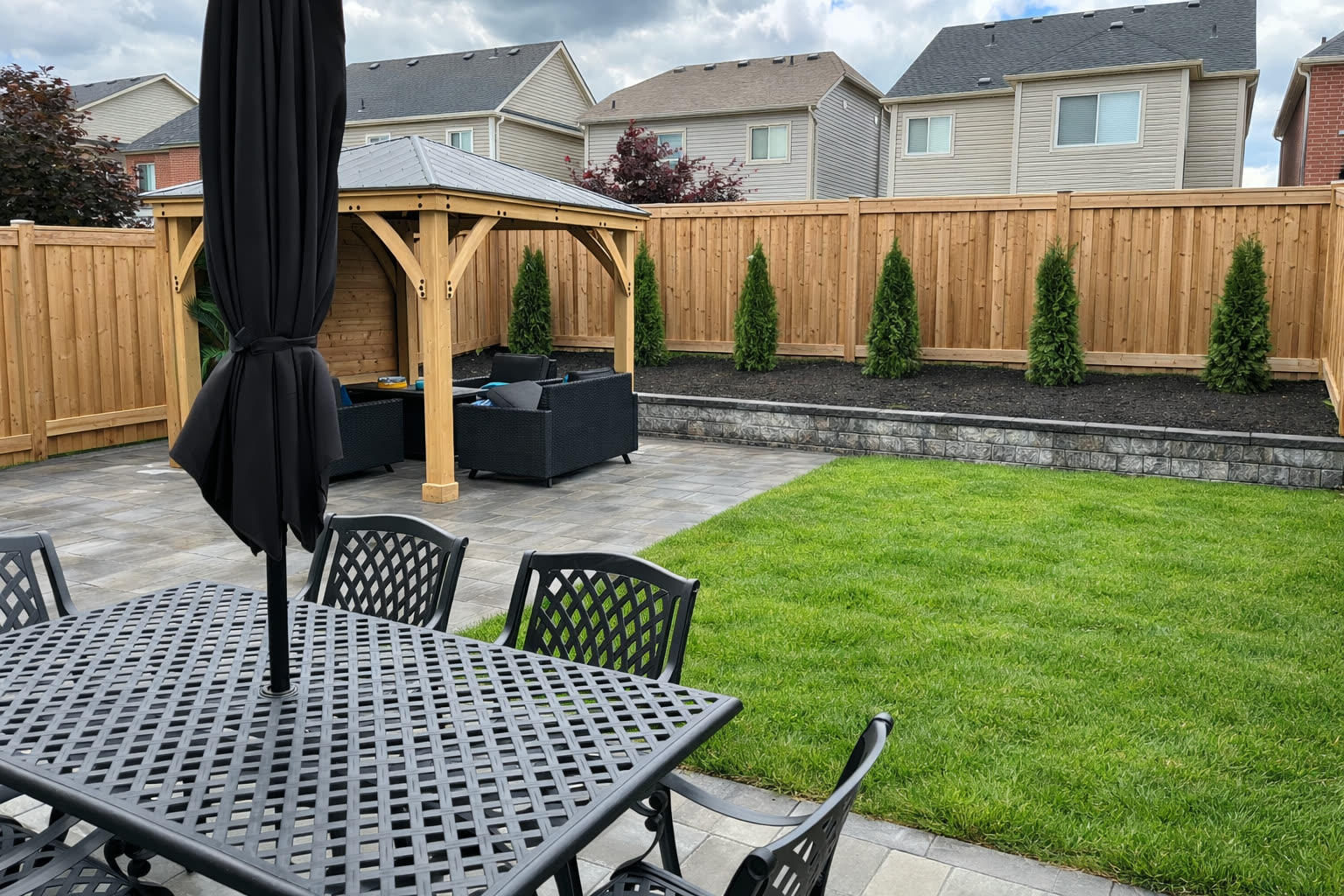
A pergola costs $13,000–$25,000 installed in Barrie; a pavilion runs $18,000–$45,000; a gazebo sits in between at $12,000–$30,000. For resale value, a cedar or composite pergola paired with an interlocking patio typically returns the most dollars per square foot in Barrie’s market. A pavilion wins on all-weather usability if you entertain through the shoulder season from May through October. The right call depends on your lot size, how you use the space, and how much annual maintenance you want.
Every spring we field the same cluster of questions from Barrie and Innisfil homeowners who spent the winter planning: should we add a pergola, or is a gazebo a better call? What’s actually the difference? The honest answer is that the right structure depends on three things — how you use your backyard, your lot’s drainage and setback situation, and what the comparable homes on your street already have.
The differences aren’t just cosmetic. A pergola, pavilion, and gazebo behave entirely differently during a January ice storm or an August thunderstorm off Georgian Bay. We’ve installed all three across the Highway 400 corridor, and each structure has a clear use case where it wins — and a scenario where spending the money is the wrong move.
Below we cover installed costs for Barrie and Simcoe County in 2026, what each structure can and can’t do in our climate, which holds up best against freeze-thaw cycles, and what the resale data actually says about value in this specific market.
What’s the Real Difference Between a Pergola, Pavilion, and Gazebo?
All three are outdoor shade structures, but that’s where the similarity ends. A pergola is an open-frame overhead structure — beams and rafters with no solid roof covering. It provides partial shade through the open spacing and is by far the most common structure we install over interlocking stone patios in Barrie. Most pergolas are either attached to the house exterior or freestanding on a patio base. The open design means rain still gets through, which is fine for most Simcoe County homeowners who primarily use the space during dry evenings.
A pavilion is fully roofed and open on the sides. Think of it as a permanent outdoor room with a solid ceiling — cedar shingles, metal standing seam, or polycarbonate panels are the common choices in this region. A pavilion turns a patio into a genuinely weather-protected space you can use during a mid-June downpour or a cool September evening without retreating inside. It’s the most functional of the three structures.
A gazebo falls somewhere between the two: it has a solid roof but typically includes decorative side panels, lattice walls, or screening. Gazebos are usually octagonal or hexagonal, which gives them a more ornamental presence. They work well as a garden focal point near a pond, pool, or perennial bed, but they’re less practical as a primary entertaining space because of their fixed geometry and smaller interior footprint.
The practical hierarchy: a pergola is the most versatile (scales from 10×10 ft to 14×20 ft, integrates with any patio layout); a pavilion is the most functional for all-weather use; a gazebo is the most ornamental and best suited as a destination point rather than a main entertaining area. When a Barrie homeowner tells us they want an outdoor living space, we almost always start with pergola or pavilion options because a gazebo tends to define a specific spot rather than create usable square footage.
Installed Costs in Barrie in 2026: What Each Structure Actually Runs
Installed costs vary significantly depending on material, size, roof type, and whether we’re setting footings into Barrie’s clay soil with helical piers or poured concrete. Frost line in Barrie is 1.2 m, so every footing has to go below that — a cost that surprises homeowners who received a quote from a supplier who didn’t account for proper frost protection.
Pergola (installed cost, 2026): Pressure-treated pine framing starts at $13,000–$16,000 for a 10×12 ft structure. A cedar pergola runs $15,000–$20,000 for the same footprint. Composite or aluminum pergolas with adjustable louvres — increasingly popular for their zero-maintenance profile — run $19,000–$25,000 installed. The louvred aluminum option allows shade on demand without the annual sealing cycle that cedar requires.
Pavilion (installed cost, 2026): A 12×16 ft cedar pavilion with a shingled roof typically runs $18,000–$28,000 installed. Metal-roof versions (standing seam or corrugated) add $2,000–$5,000 to that but last significantly longer in Simcoe County’s freeze-thaw environment. Larger pavilions — 16×20 ft with electrical rough-in, ceiling fan, and a natural gas line stubbed out for a heater or outdoor kitchen — can reach $35,000–$45,000.
Gazebo (installed cost, 2026): Prefab vinyl gazebos in the 12 ft octagonal range start around $7,000 supply-only; installed with a proper base and footings, $12,000–$16,000. A custom cedar gazebo built on-site with a cupola and cedar shingle roof runs $20,000–$30,000. We generally recommend vinyl over cedar for gazebos in this climate because the curved rails and detailed trim on a cedar gazebo are expensive to maintain and repaint every 2–3 years.
Key cost drivers across all three structure types: footing depth and type (helical piers cost more than poured concrete but perform better in Barrie clay), size in square feet, material selection (pressure-treated vs. cedar vs. composite vs. vinyl vs. aluminum), roof type (open lattice vs. solid), and whether electrical, gas, or landscape lighting is integrated. Use our project cost estimator to get a rough range for your setup before requesting a formal site visit.
How Each Structure Holds Up Through Barrie’s Freeze-Thaw Winters
Barrie sees 60–85 freeze-thaw cycles per year, and the city’s predominant clay soil — particularly west of Bayfield Street through the south-end subdivisions — makes post heave a real risk for any structure set on shallow footings. This is one of the most under-discussed differences between the three structure types, and it’s where cut-rate installations fall apart within five years.
Pergolas have one advantage in a snow climate: the open roof means no snow load accumulates overhead. The risk zone is the post base detail. We spec helical piers or above-grade post bases with proper air gaps to prevent moisture from wicking from Barrie clay into the end grain of the posts. A pressure-treated pine post set directly in concrete in clay soil can begin checking and deteriorating within 5–7 years. Cedar in a proper above-grade base outlasts it considerably. The open roof also means ice-dam formation isn’t a concern, which keeps the structure’s long-term maintenance simpler.
Pavilions with solid roofs must be designed for snow load. The City of Barrie requires structures to handle a ground snow load of 2.0 kPa — roughly 200 kg per square metre. A 12×16 ft pavilion with a flat or low-pitched roof accumulates significant weight during a heavy Barrie snowfall. We spec a minimum 4:12 roof pitch and size the beams accordingly. Metal roofing sheds snow faster than cedar shingles and eliminates the freeze-thaw moisture cycling in the roofing layer itself — which is why we prefer it for pavilions serving as primary entertaining structures.
Gazebos distribute vertical load well through their octagonal geometry, but most prefab gazebo kits spec 4×4 posts — underbuilt for anything larger than 10 ft across in a high-snow zone. We upgrade to 6×6 posts on any gazebo exceeding 12 ft in diameter and set them on poured concrete piers below the 1.2 m frost line. A well-detailed cedar gazebo with proper post bases and quality cedar shingles can last 20–25 years in Simcoe County before requiring major structural work.
Which Structure Adds the Most Resale Value to a Barrie Home?
Resale value is a nuanced question, and we’re going to give you the honest version: no outdoor structure returns dollar-for-dollar at resale. The real question is which structures improve list appeal and reduce days on market versus which ones register as a maintenance liability in a buyer’s mind.
In Barrie’s south-end neighbourhoods — Holly, Ardagh, Innis Shore, and the Essa Road corridor — a cedar or composite pergola over an interlocking stone patio is the outdoor feature that most reliably adds to list appeal. Buyers in the $650,000–$950,000 range see it as a lifestyle signal: they picture themselves using that space without asking what it costs to maintain. A well-installed pergola over a Unilock or Techo-Bloc patio base typically returns $10,000–$16,000 on a $15,000–$20,000 investment — a 65–80% return at resale. That’s not dollar-for-dollar, but it’s meaningfully better than a pool.
Standalone gazebos in the middle of a lawn tend to perform the worst at resale. They often return 40–50 cents on the dollar because buyers price in the upkeep. A gazebo that hasn’t been maintained communicates deferred maintenance more broadly — it colours the buyer’s impression of the rest of the property.
Pavilions are the exception at the upper end of the market. A fully outfitted pavilion with integrated lighting, a ceiling fan, outdoor kitchen rough-in, and a paved base in Barrie’s $850,000–$1.1M tier can return close to full cost because the buyer demographic at that price point expects an outdoor room. Without the full package, a bare-bones pavilion structure by itself doesn’t move the needle as predictably.
If resale value is the primary driver, our consistent recommendation is a cedar or aluminum pergola paired with a quality paver patio base. For project examples, see our portfolio of Barrie and Innisfil installs. More detail on return by project type is covered in the backyard renovation ROI guide.
How to Choose the Right Structure for Your Lot, Use Case, and Budget
The practical decision comes down to four questions: How big is your backyard? How do you actually use outdoor space? How much annual maintenance are you willing to commit to? And what does the rest of your yard already look like?
Small lots (under 500 sq ft of backyard) — common in Barrie’s Heritage Estates, Painswick, and south-end townhouse pockets — benefit most from a pergola. A 10×12 ft or 10×14 ft pergola over a paved patio creates an outdoor room without consuming all the remaining green space. Freestanding pergolas in this size range also require the least disruption during installation and typically have the shortest permit review cycle.
Medium lots (700–1,500 sq ft of backyard) have enough room for a pavilion, but position matters. A pavilion tucked into a rear corner loses the sightline and feels isolated; anchoring it adjacent to the main patio and orienting it toward the yard gives the space an indoor-outdoor flow that actually gets used. Most of the 14×18 ft pavilions we build in Barrie fall into this lot-size category.
Larger lots (1,500+ sq ft) near Lake Simcoe or in Innisfil, Oro-Medonte, or Springwater often suit a gazebo as a secondary structure — near a water feature or garden bed — with a primary pergola or pavilion anchoring the main entertaining zone. The gazebo reads as a destination point in a larger space in a way it can’t on a typical suburban lot where it just looks marooned in the lawn.
On maintenance expectations: cedar requires sealing or staining every 2–3 years; pressure-treated pine needs annual attention. Composite and aluminum are effectively zero-maintenance but cost more upfront. Vinyl gazebos hold their finish well in Simcoe County’s UV environment and through winter freeze-thaw cycles but can take on a slight yellow cast after 10–12 years without regular cleaning.
Visit our Barrie landscape design page to walk through your specific backyard with us before committing to a structure type. We do a proper site assessment — looking at grades, drainage, setbacks, and sun exposure — before making any design recommendation.
Permits and Setbacks for Backyard Structures in Barrie and Simcoe County
This is the section most contractors skip, which is why homeowners get surprised mid-project. Knowing the permit rules upfront saves weeks of delay and protects you at resale.
The City of Barrie requires a building permit for any accessory structure — pergola, gazebo, or pavilion — with a floor area exceeding 10 sq m (approximately 107 sq ft). A standard 10×12 ft pergola is 111 sq ft, which already clears the threshold. The permit package includes a site plan showing setbacks from property lines, a framing plan with beam and post sizing, and — for heavier structures — a footing design. If electrical is included, an ESA permit is also required separately.
Rear yard setbacks in most Barrie residential zones require the structure to sit at least 1.2 m from the rear property line. Side yard setbacks vary by zoning designation — typically 1.2 m on interior lots, larger on corner lots. If you’re in a waterfront-adjacent zone along the Lake Simcoe shoreline, in Shanty Bay, or in any area under the Lake Simcoe Protection Plan, setback requirements tighten considerably and may require a variance application or Conservation Authority review.
Attaching a pergola directly to the house changes the permit category. In many City of Barrie interpretations, an attached pergola becomes part of the principal structure and triggers an addition review rather than a simple accessory structure permit. We clarify this upfront with the building department before finalizing the design to avoid resubmissions.
If your property is in Innisfil, Oro-Medonte, Springwater, Midland, or Collingwood (not City of Barrie proper), the rules differ — some townships have higher thresholds for permit-exempt structures. We work across all of these jurisdictions and pull the correct permit type for each municipality as part of our process.
We handle permit applications and site plans as part of every installation. If you’re comparing quotes and one contractor didn’t mention permits, that’s a flag: you’re the property owner of record, and an un-permitted structure can complicate home sales and insurance claims. Get a proper quote through our contact page and we’ll confirm what’s required for your specific address before anything goes in the ground.
Pergola vs. Pavilion vs. Gazebo: Barrie 2026 side-by-side comparison
| Feature | Pergola | Pavilion | Gazebo |
|---|---|---|---|
| Installed cost (Barrie, 2026) | $13,000–$25,000 | $18,000–$45,000 | $12,000–$30,000 |
| Rain protection | None (open roof) | Full (solid roof) | Full (solid roof) |
| Snow load concern | Low (open roof sheds snow) | High (needs 4:12+ pitch) | Moderate (octagonal geometry helps) |
| Typical footprint | 10×10 to 14×20 ft | 12×16 to 18×24 ft | 10–16 ft diameter |
| Best use case | Patio shade, outdoor room | All-weather entertaining space | Garden focal point |
| Resale value signal | Strong (65–80% return) | Strong in upper market tier | Moderate (40–50% if not maintained) |
| Annual maintenance | Low–moderate (cedar sealing) | Low–moderate (roof inspection) | Low (vinyl) / High (cedar trim) |
| Permit required in Barrie | Yes (over 107 sq ft) | Yes | Yes (over 107 sq ft) |
Frequently Asked Questions
How much does a pergola cost installed in Barrie Ontario in 2026?
A cedar pergola installed in Barrie typically costs $15,000–$20,000 for a 10×12 ft to 12×16 ft structure in 2026. Pressure-treated pine framing starts lower at $13,000–$16,000. Aluminum louvred pergolas with adjustable blades run $19,000–$25,000 installed. The main cost variables are size, material, footing type, and whether electrical or lighting is included.
Do I need a permit for a pergola or gazebo in Barrie?
Yes. The City of Barrie requires a building permit for any accessory structure over 10 sq m (about 107 sq ft). A standard 10×12 ft pergola is 111 sq ft, which triggers the permit requirement. The process includes a site plan, framing plan, and setback confirmation. If you attach the pergola to the house, the permit category changes to an addition review, which has a different process.
Which adds more resale value to a Barrie home: a pergola or a gazebo?
A pergola over an interlocking patio consistently outperforms a standalone gazebo at resale in Barrie. A well-installed cedar or composite pergola typically returns 65–80% of its installed cost in list appeal, compared to 40–50% for a standalone gazebo. Gazebos often register as a maintenance liability to buyers when not kept up, which can negatively colour their impression of the whole property.
What is the difference between a pergola and a pavilion?
A pergola has an open lattice or beam roof that provides partial shade but no rain protection. A pavilion has a solid roof — typically cedar shingles, metal standing seam, or polycarbonate — that provides full weather protection overhead while remaining open on the sides. A pavilion functions as an outdoor room usable through shoulder-season rain; a pergola works best during dry conditions.
Can a pergola handle Barrie winters without heaving or rotting?
Yes, if it’s built with the right details. The open roof means no snow accumulation overhead, which removes the snow load concern. The critical detail is the post base: posts should not be set directly in concrete in Barrie’s clay soil, which wicks moisture and causes freeze-heave. We use helical piers or above-grade post bases set below the 1.2 m frost line to prevent movement and end-grain moisture exposure.
How big should a pergola be for a typical Barrie backyard?
For a typical Barrie suburban lot with 500–800 sq ft of backyard, a 10×12 ft or 10×14 ft pergola is the right scale — large enough to seat 6–8 people around a table without consuming the entire yard. For larger lots in Innisfil or Oro-Medonte with 1,500+ sq ft of yard space, a 14×16 ft or 14×20 ft structure gives the space the visual weight it needs.
Is a pavilion worth the extra cost over a pergola in Barrie?
It depends on how you use the space. If you primarily entertain in July and August on dry evenings, a pergola at $13,000–$25,000 delivers the same outdoor room feel at a fraction of the cost. If you want to use the space from May through October regardless of weather — and you’re already investing in an interlocking patio base — the extra $10,000–$20,000 for a pavilion typically pays off in actual usability.
What is the cheapest permanent shade structure for a Barrie backyard?
A pressure-treated pine pergola on a 10×10 ft or 10×12 ft footprint is the most cost-effective permanent shade structure we install, starting at $13,000–$16,000 installed. It requires annual sealing to hold up through Simcoe County’s freeze-thaw cycles, but it’s a solid entry point if budget is the primary constraint. Cedar costs more upfront but carries lower annual maintenance than pressure-treated.

Yorkis Estevez founded Golden Maple Landscaping in 2020 and has installed pergolas, pavilions, and gazebos across Barrie, Innisfil, and Simcoe County. The company is WSIB certified and carries $5M in liability coverage. With a 5.0 Google rating, the work ethic is the same on a $10,000 pergola as on a $100,000 backyard renovation: proper footings, right materials for the climate, and no shortcuts on permits or base prep.
If you’re weighing a pergola, pavilion, or gazebo for your Barrie or Simcoe County property, the best next step is a site visit. We look at your lot size, setbacks, existing patio or foundation, drainage, and how you actually use the space before recommending a structure. Reach out through our contact page to schedule a consultation, or use the cost estimator to get a rough project range before we talk.