
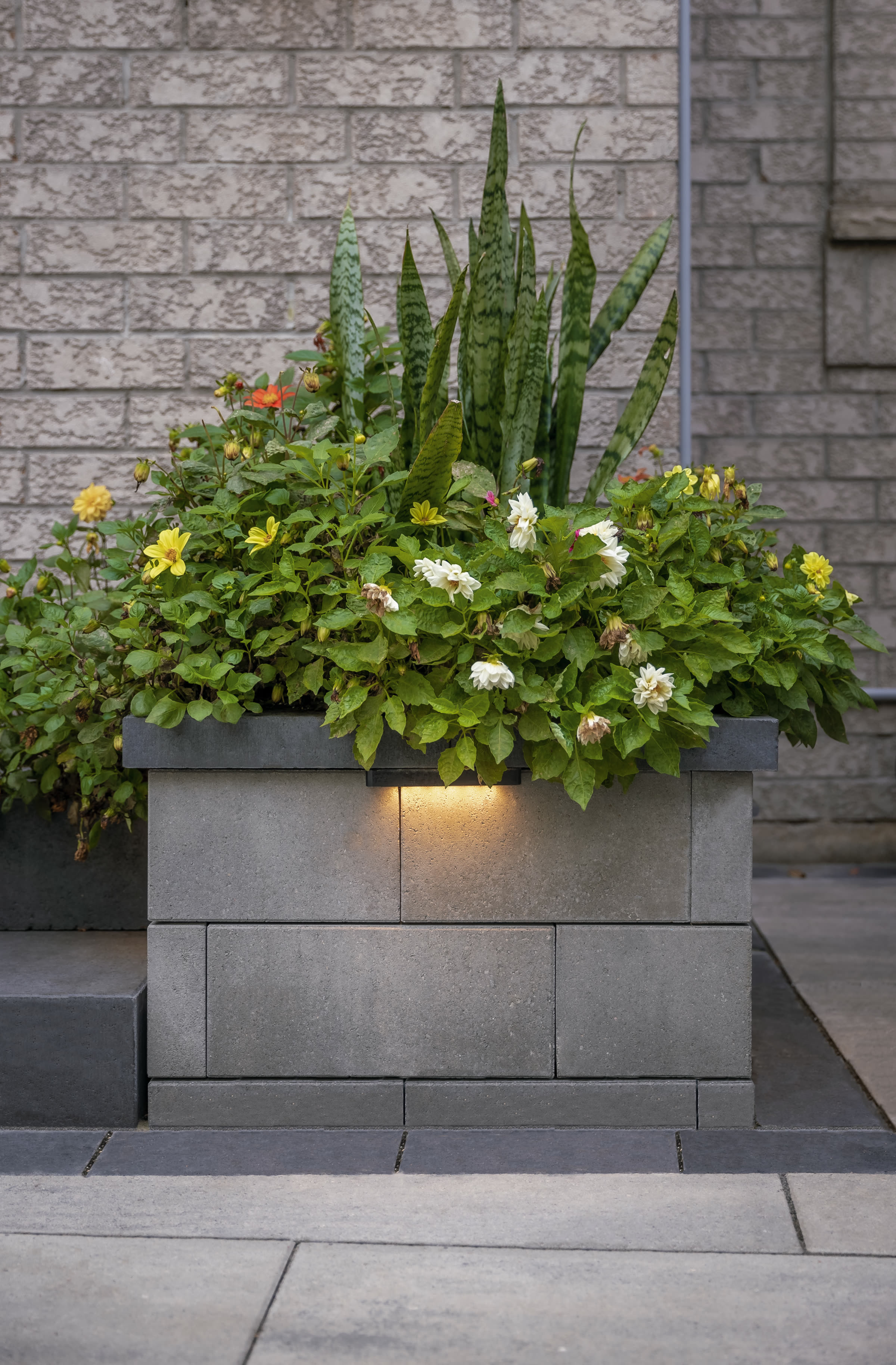
A single-tier retaining wall in Oro-Medonte runs $150–$300 per linear foot installed, or $4,500–$9,000 for a typical 30-foot run. Height is the primary cost driver: walls over 1 metre need compacted clear stone drainage and often geogrid reinforcement. Walls above 1.2 metres typically require an engineer under Ontario Building Code. Permacon, Unilock, and Techo-Bloc are the three block lines we install — each holds up well through Simcoe County\'s freeze-thaw cycles.
Oro-Medonte sits on some of the most varied terrain in Simcoe County — drumlin ridges, rolling Shield-country hills, and waterfront lots with steep drops toward Lake Simcoe. That topography is beautiful, but it means a lot of properties need retaining walls to manage grade, hold soil in place, and protect foundations from hydrostatic pressure. When clients call us for a retaining wall quote, the honest answer is always: it depends on four things — wall height, block type, drainage complexity, and whether an engineer needs to sign off.
This breakdown covers what we actually charge and why, based on projects we have completed across Oro-Medonte, Barrie, and Springwater. We walk through material options including Permacon, Unilock, and Techo-Bloc, explain when Ontario's Building Code requires engineering, and cover the drainage work that most contractors quietly skip — which is exactly why so many walls begin to lean or blow out within five to ten years of installation.
If you want a number specific to your property, our cost estimator will get you in the ballpark. For a full on-site assessment with a fixed quote, reach out directly — we cover all of Oro-Medonte and the surrounding townships of Barrie, Springwater, and Innisfil.
What Does a Retaining Wall Actually Cost in Oro-Medonte in 2026?
Here is what we are seeing in the field for installed retaining walls in Oro-Medonte and the broader Simcoe County area in 2026:
- Basic single-tier wall (under 900 mm high, 20–30 linear feet): $4,000–$8,500 total
- Mid-range wall (1,000–1,500 mm, 30–50 linear feet, with drainage system): $7,500–$18,000
- Engineered wall (over 1.5 m or tiered system, full drainage and geogrid): $18,000–$45,000+
On a per-linear-foot basis, pricing ranges from $150 to $350 for most residential projects. The low end is a short wall on flat, accessible ground with easy equipment reach. The high end is a tall wall on a steep slope with poor vehicle access, engineered drawings, geogrid reinforcement layers, and a complete weeping-tile drainage system behind the block.
What surprises most clients is how non-linear the cost curve is. A wall that is 1.5 m high does not cost 50% more than a 1.0 m wall — it costs roughly double once you account for the deeper excavation, the wider drainage envelope, the additional block per course due to batter setback, and the likelihood that engineering drawings become mandatory. Every 300 mm of height cascades through the entire job cost.
Square-footage pricing (based on face area) runs $55–$120 per sq. ft. installed. We tend to quote retaining walls by the linear foot rather than face area because height is the real multiplier, and face-area pricing can obscure total project cost — particularly on taller walls where the face area rises fast but the drainage and engineering costs rise faster.
These ranges apply to concrete block walls using Permacon, Unilock, or Techo-Bloc. Armour stone and natural fieldstone typically run 20–40% higher on materials alone and require heavier equipment, which adds further to the installed cost.
The Four Variables That Drive Retaining Wall Cost
In our experience quoting and building retaining walls across Oro-Medonte's varied terrain, four variables account for almost all of the price spread between a $5,000 job and a $30,000 job.
1. Wall height. This is the dominant variable and the one most homeowners underestimate. A wall that is 1,200 mm tall instead of 800 mm is not 50% more expensive — it is roughly double once excavation depth, drainage trench volume, block quantity, and geogrid requirements are all counted. Taller walls also trigger engineering and permit requirements under Ontario Building Code, which adds $1,500–$3,000 to the job.
2. Site access. Oro-Medonte properties often have narrow laneways, mature trees, or rear lots that cannot be reached with a standard excavator. When equipment cannot get to the wall location, labour costs climb — sometimes by 30–40% on the base excavation alone. Hand-digging a drainage trench is expensive and slow.
3. Soil and subgrade conditions. Barrie clay is notorious for holding water, and much of Oro-Medonte sits on similar clay-heavy glacial till. That means natural drainage cannot be relied upon — it has to be engineered into the wall system. Properties closer to the Precambrian Shield, by contrast, sometimes have so much bedrock near the surface that precision excavation is required, which adds a different kind of cost.
4. Drainage — the variable most contractors skip. A properly built retaining wall includes 12–16 inches of compacted clear stone directly behind the block, a perforated weeping tile at the base running to daylight or a catch basin, and filter fabric separating the drainage stone from native soil. We use compacted clear stone (never granular A) because its open aggregate structure lets water escape rather than build hydrostatic pressure. This drainage package adds $25–$50 per linear foot. Walls built without it typically show movement within three to seven years.
Block Choices: Permacon, Unilock, and Techo-Bloc Side by Side
We are certified installers for Permacon, Unilock, and Techo-Bloc — all three available through Carr Landscape Depot in Barrie. Each manufacturer has a dedicated retaining wall product line, and they are not interchangeable for every application. Here is how they compare in practice.
Permacon retaining wall products — including the Soca and Ledgestone lines — are the most cost-competitive of the three. They are solid performers for walls up to 1,000 mm and work well when the wall needs to match a Permacon paver driveway or patio on the same property. Rough material cost runs $18–$28 per linear foot of finished wall face, depending on block size and colour selection.
Unilock offers the Brussels Dimensional and Tuscany retaining systems. These have a more refined, architectural finish and a wider colour range, which is why they are popular on estate lots in Oro-Medonte where the wall is a visible design feature rather than a purely functional grade change. Material costs run $24–$38 per linear foot.
Techo-Bloc products — particularly the Classico Retaining and Vertica lines — sit at the top of the price range but offer the tightest production tolerances and most consistent texture. They are a strong choice when the wall doubles as a backdrop for an outdoor living space or patio on a hillside lot. Material costs: $30–$45 per linear foot.
All three block systems perform well in Ontario's freeze-thaw climate when installed with adequate drainage. The failure mode is almost never the block itself — it is the drainage system behind it. For a broader product comparison, see our Retaining Wall Guide for Simcoe County. If you are on an Oro-Medonte property and want a recommendation specific to your grade and soil type, our Oro-Medonte location page has project examples from the area.
Engineering and Permits: When Ontario Building Code Applies in Oro-Medonte
In Ontario, the Building Code requires a building permit — and structural drawings approved by a licensed professional engineer — for retaining walls that exceed 1 metre in height measured from the bottom of the footing to the top of the block. Oro-Medonte Township follows OBC requirements, and the municipality may impose additional setback requirements for walls near property lines or watercourses draining toward Lake Simcoe tributaries.
In practice, walls legitimately below 1 m are commonly built without a permit. Walls we build above that threshold go through the permit process — structural drawings from a licensed engineer, submission to the municipality, and inspection at the relevant construction stages. Engineering drawings typically cost $1,200–$2,500 depending on wall height and complexity. Permit fees in Oro-Medonte are generally $200–$600 for a residential retaining wall.
Be cautious of any contractor who proposes a 1.4 m wall and suggests skipping the permit because the neighbours never pulled one. In Ontario's liability framework, an unpermitted wall that fails near a property line or road is not just a repair problem — it is a liability problem that falls entirely on the property owner. We have seen this scenario play out, and it is not a pleasant one.
For tiered wall systems — multiple shorter walls terraced up a slope — engineering is best practice even when each individual tier is technically under 1 m. The surcharge load from the upper tier places lateral force on the lower one, and both need to be designed together to load-balance correctly. We discuss this with clients who want to avoid engineering costs: tiering can be the right call for aesthetic or budget reasons, but it needs to be engineered to work safely. For more on permit requirements in Simcoe County, see our retaining wall regulation guide or speak directly with our Oro-Medonte team.
What a Proper Retaining Wall Quote Should Include — Line by Line
A solid retaining wall quote should break out every major cost component. If yours does not, here is what to ask for before signing anything.
- Excavation and haul-away: Cutting into a hillside generates significant spoil that has to go somewhere. Haul-away is not always included in base quotes. Expect $800–$2,500 for excavation and disposal on a typical Oro-Medonte wall project, depending on volume and trucking distance.
- Drainage stone: Confirm the spec is compacted clear stone (19 mm crushed or larger), not granular A. Granular A is a road base product that retains moisture — it is not a drainage medium. The drainage layer should be 12–16 inches behind the block face.
- Weeping tile and outlet: A 100 mm perforated pipe at the base of the wall running to a clear daylight outlet or a catch basin. This is non-negotiable on any wall over 900 mm. Ask specifically where the pipe outlets — a contractor who cannot answer that question has not built the drainage system.
- Geogrid reinforcement: For walls over 900–1,200 mm, a geogrid layer buried into the compacted fill at defined intervals behind the wall is typically required. Permacon, Unilock, and Techo-Bloc all publish geogrid schedules for their wall products — a qualified installer follows those schedules exactly.
- Engineering and permit fees: These should be a separate line item, not buried in a lump sum. If the quote does not mention them and the wall is over 1 m, ask why.
- Cap block or coping: The finished top course. Sometimes quoted separately. Confirm it is included and that the cap ties back into the block system properly.
When comparing quotes, remember that the cheapest price is rarely the cheapest wall. A $7,000 quote with no drainage line item against an $11,000 quote with full drainage is not a $4,000 saving — it is a $4,000 deposit on a wall that will need rebuilding.
Retaining wall block comparison: Permacon vs. Unilock vs. Techo-Bloc for Oro-Medonte installations
| Feature | Permacon (Soca / Ledgestone) | Unilock (Brussels / Tuscany) | Techo-Bloc (Classico / Vertica) |
|---|---|---|---|
| Material cost (per lin. ft.) | $18–$28 | $24–$38 | $30–$45 |
| Best application | Functional walls; matches Permacon patio | Architectural finish; estate lots | Premium outdoor living backdrops |
| Texture / colour options | Moderate selection | Wide selection | Very wide selection |
| Geogrid compatibility | Yes — published schedule | Yes — published schedule | Yes — published schedule |
| Freeze-thaw performance (Ontario) | Excellent | Excellent | Excellent |
| Available at Carr Landscape Depot | Yes | Yes | Yes |
Frequently Asked Questions
Does Oro-Medonte require a permit for a retaining wall?
Yes, if the wall exceeds 1 metre in height measured from the bottom of the footing. Walls below that threshold are generally exempt under Ontario Building Code, though you should confirm specific setback requirements with Oro-Medonte Township for your lot. We pull all required permits and coordinate engineering drawings as part of the project scope.
How long does a retaining wall last in Ontario's climate?
A properly built concrete block wall — Permacon, Unilock, or Techo-Bloc — with adequate drainage behind it should last 30–50 years through Ontario's freeze-thaw cycles. Walls that fail early almost always fail for the same reason: hydrostatic pressure from water that built up behind the block because no drainage system was installed. The blocks themselves rarely fail — the drainage does.
What is the cheapest retaining wall option in Simcoe County?
For a low wall under 600 mm, a Permacon Ledgestone dry-stack system is the most cost-effective installed option, running $130–$180 per linear foot with a basic gravel base. For anything taller, cutting corners on the drainage system costs more in repairs than it saves upfront. Pressure-treated timber walls are cheaper initially but typically need replacement within 10–15 years in Simcoe County's wet soil conditions.
Can I build a retaining wall myself in Oro-Medonte?
For low decorative walls under 600 mm on flat ground, a capable DIYer can get a reasonable result with proper base preparation. Above that height, the drainage design, batter calculations, and geogrid schedules are genuinely technical. We repair a significant number of DIY walls in the 800–1,200 mm range that were built without adequate drainage or proper base work — typically within three to five years of construction.
Do retaining walls need maintenance in Ontario?
Minimal maintenance is required for a well-built wall. Annually check that the drainage outlet (weeping tile pipe) is clear and not blocked by debris or ice. Inspect for any forward lean — more than 25 mm of movement in the top course warrants a professional assessment. Polymeric sand in any cap joints should be reapplied every five to seven years as it breaks down.
How do tiered retaining walls affect cost?
A tiered wall system — two or three shorter walls terraced up a slope — generally costs 15–30% more per linear foot than a single tall wall of equivalent total height, primarily because each tier requires its own excavation, drainage layer, and footing preparation. The advantage is that tiers under 1 m each may avoid the engineering and permit requirement that applies to a single wall over 1 m, but this should be confirmed with the municipality before assuming it applies to your property.
Does a retaining wall add property value in Oro-Medonte?
A well-built retaining wall that solves a visible grade problem — common on the sloped lots throughout Oro-Medonte — typically recoups 60–80% of its cost in resale value and often more when it opens up usable yard space that was previously unusable hillside. Home inspectors and buyers notice failing walls, so a neglected or poorly built wall can reduce value rather than add it.

Yorkis Estevez founded Golden Maple Landscaping in 2020 and has since overseen hundreds of hardscape installations across Barrie, Oro-Medonte, and Simcoe County. The company holds WSIB certification, $5M in liability coverage, and a 5.0-star Google rating. Yorkis brings hands-on oversight to every retaining wall project, from permit coordination to final drainage inspection.
If you have a grade problem on your Oro-Medonte property — or anywhere across Simcoe County — we do a full on-site assessment before quoting. We look at your soil, access, wall height, and drainage path before we put a number on paper. Book a site visit or use the cost estimator to get a ballpark first. We build in Barrie, Oro-Medonte, Innisfil, Springwater, Orillia, Wasaga Beach, Midland, and Collingwood.