
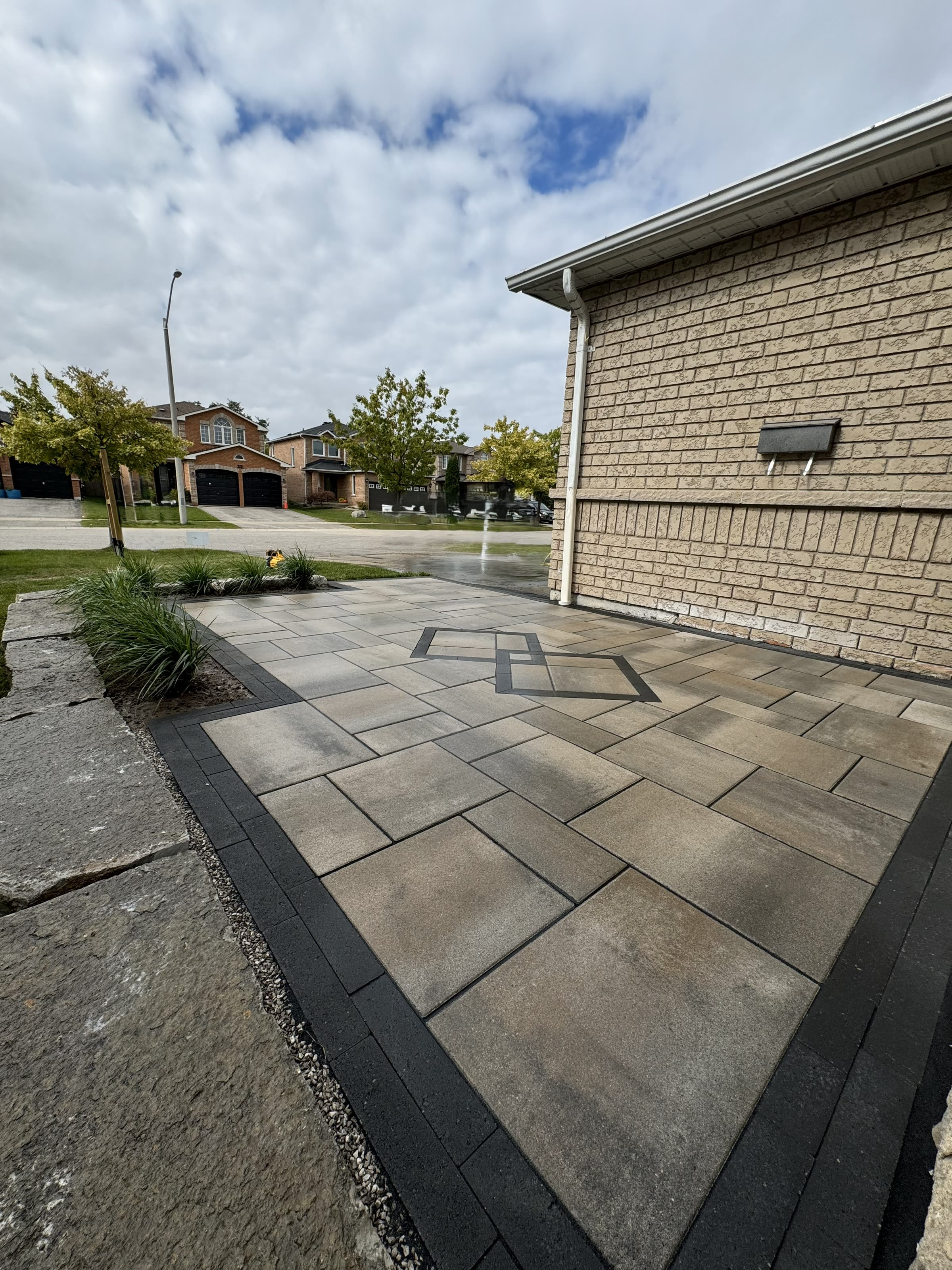
Every interlocking failure we get called out to inspect in Barrie has the same root cause. Not bad pavers. Not bad weather. Not bad workmanship on the surface. It's the base material underneath.
And in this region, that material is almost always Granular A — the default base aggregate that 95% of contractors quote, install, and walk away from. It's cheap, it's familiar, and in Simcoe County's freeze-thaw climate, it is the single biggest predictor of how fast your hardscape will fail.
We don't use it. Not on $15,000 patios, not on $120,000 pool decks, not anywhere. Here's the engineering reason — and why the alternative is the only base we'll ever build on.
What Granular A Actually Is
Granular A is a dense-graded aggregate. That means it's a deliberate mix of stone sizes — from coarse 19mm down to fine dust — engineered to pack as tightly as possible. When you compact it, every tiny particle fills the gap between bigger ones. The result is a base that's incredibly dense and stable for road construction.
That last word matters. Granular A was developed by the Ontario Ministry of Transportation for highways and arterial roads, where the surface is asphalt and water runs off the surface, never through it. In that context, it's perfect. Dense, stable, predictable.
The Problem When You Put Pavers on Top
Interlocking pavers aren't asphalt. Water doesn't run off — it runs through the joints, especially in the first few years before polymeric sand fully cures. That water has to go somewhere.
Under a Granular A base, it has nowhere to go. The fines in Granular A — the silty dust that makes it pack so tight — also make it virtually impermeable once compacted. Water hits the base, can't drain through, and pools at the top. In summer, that's just a slow source of weeds and joint erosion. In winter, it's a guaranteed failure mechanism.
The Freeze-Thaw Failure, Step by Step
Here's what physically happens to a Granular A base over a Barrie winter:
- October rain saturates the top inch of your base through the paver joints. The fines hold that water like a sponge.
- First freeze in November. Water expands 9% as it turns to ice. Your base inflates. Pavers lift a millimetre or two — not enough to see yet.
- December thaw. Ice melts, water drops back down, pavers settle — but not exactly to where they started. Microscopic movement.
- This cycle repeats 40 to 60 times. Simcoe County averages 50 freeze-thaw days per winter. Multiply.
- By April, you've got visible lippage, widening joints, edge creep, and puddles where the surface used to drain.
It's not bad luck. It's physics. A water-holding base in a freeze-thaw climate is going to fail. The only question is how fast — and the answer is "faster than you expect."
The ICPI Open-Graded Standard
The Interlocking Concrete Pavement Institute — the industry body that actually does the engineering research on this — has been recommending open-graded bases for over a decade. It's the standard for permeable pavement systems, and the better contractors apply it to all their installations, permeable or not.
Open-graded means the opposite of Granular A. Instead of a mix of sizes that pack tight, you use a uniform-size stone that can't pack tight by design. The voids between stones stay open. Water moves through them as fast as it arrives. Nothing pools, nothing sits, nothing freezes in a layer that can heave your pavers.
What We Actually Use
At Golden Maple, every hardscape build sits on this two-layer open-graded system:
- Base course: 3/4" clear stone (HL-8 / 19mm crusher run washed clean). This is the structural layer — usually 8 to 14 inches deep depending on soil and load. Compacts to 95%+ density in lifts, holds shape under traffic, and drains at roughly 250 inches per hour. For comparison, Granular A drains at <1 inch per hour after compaction.
- Bedding course: HPB (High Performance Bedding). A 1 to 1.5 inch layer of small angular chip directly under the pavers. Levels the surface to ±2mm tolerance and stays put under load — won't migrate the way concrete sand does in the first heavy rain.
The cost difference per square foot is small — usually $1.50 to $2.50 more in materials. The lifespan difference is enormous. We back our base work with a 5-year sink and settlement warranty, and we've never had to honour a claim. You can't say that on Granular A and stay in business.
Why Most Barrie Contractors Still Use Granular A
Three reasons, and none of them are good for you:
- It's what they learned. Granular A has been the default in Ontario residential hardscape for 30 years. Changing means re-learning compaction technique, sourcing different aggregate, and explaining the upgrade to clients. Most don't bother.
- It's cheaper at the quarry. By maybe $8 per cubic yard. On a typical 500-square-foot patio that's a $60 to $100 swing in material cost. Contractors quoting low margins protect that $100.
- The failure shows up after they're gone. A Granular A patio looks beautiful on day one. It looks beautiful at the one-year walkthrough. By year three, when the lippage starts, the contractor has cashed the cheque and moved on to the next job.
If you've ever wondered why every contractor in town quotes "essentially the same thing," this is one of the places where the same isn't actually the same. The hidden costs of cheap landscaping almost always trace back to a corner cut on the base.
How to Verify What Your Contractor is Quoting
Before you sign anything, ask three specific questions:
- "What base material are you using — Granular A or 3/4 inch clear stone?" If they hesitate or say "we use what the project needs," walk away. A real hardscape contractor will give you a one-word answer.
- "How deep is the base?" Anything less than 8 inches for a patio (or 12 inches for a driveway) is undersized for Simcoe County soil.
- "What's the bedding layer?" The correct answer is HPB or 1/4" chip. If they say concrete sand or stone dust, the bedding will migrate and your pavers will rock within 24 months.
You don't need to know the engineering to ask these questions. You just need to know what answers are correct.
The 20-Winter Test
Every hardscape we build is engineered to look the same 20 winters from now as it does the day we hand it over. That's not a marketing promise — it's a base specification. Open-graded clear stone with HPB bedding doesn't trap water. Water that doesn't sit doesn't freeze in a layer that can lift your pavers. Pavers that don't lift don't widen, don't tilt, don't crack the polymeric sand. The whole failure cascade starts with one decision underground.
You can't fix this after the fact. There's no overlay, no top-up, no sealer that compensates for a base that's holding water. The only fix is to tear the surface up, dig the base out, and start over. That's a $15,000 do-over on a $15,000 patio.
What This Means for Your Project
If you're getting quotes for an interlocking patio, retaining wall, driveway, or pool deck in Barrie, Innisfil, Oro-Medonte, or anywhere across Simcoe County, the base spec is the single most important line item on the proposal. Look for it. Question it. Compare it across quotes.
If the quote doesn't specify the base material and depth in writing, the contractor either doesn't know or doesn't want you to. Either way, that's not the team you want.
Want to see what the right base looks like in writing? Our instant cost estimator shows you a real range with the engineering included, and our free design consultation walks you through the exact base spec for your property — soil type, drainage, frost depth, the whole stack.
Related reading: Why patios sink in Barrie · Winter damage prevention · Interlocking cost in Barrie 2026.