
Interlock Driveways in Barrie
A driveway built for cars,
not just curb appeal.
A driveway is the hardest-working surface on the property. It carries a vehicle's weight every day, takes plow blades and salt all winter, and on many Barrie lots it sits on clay or silty soil that heaves when it freezes. A patio-grade base under a driveway is the most common reason interlock ruts, sinks at the apron, or pushes its border out within a few seasons.
We plan interlock driveways from the ground down: what the soil is, where the water goes, how the car turns, and what holds the edges. The paver and pattern come after that.
What a driveway scope covers
- Removal and haul-away of the old asphalt, concrete or interlock
- Excavation to a depth set by soil, drainage and vehicle use, written into the scope
- Geotextile separation over clay subgrade
- Compacted 3/4" clear stone base with high-performance bedding (HPB)
- Soldier course or border band on a concrete-backed edge restraint
- Grading that moves water away from the garage and foundation
- Polymeric sand jointing
- Clean tie-ins at the garage slab, walkway and front steps
Why driveway interlock fails in Barrie
Most failed driveways come down to three things: a base sized for foot traffic, water that sits in the base instead of draining through it, and edges with nothing holding them. Tires turning in place push sideways on the pavers. If the border isn't locked in, the field slowly walks outward and the joints open.
The clay and silty soils found on many Barrie sites make all three worse. They hold water, and water that freezes under a driveway lifts it. The fix isn't "more gravel" by default. It's separating the clay from the stone with geotextile, giving water a way out, and sizing the base for the load it actually carries.
Base, bedding and edges
Our driveway bases are compacted 3/4-inch clear stone over a geotextile separation layer, with high-performance bedding under the pavers. Clear stone is open-graded: water passes through it instead of sitting in it, which matters on sites where the subgrade drains slowly.
Driveway bases are built deeper than patio bases because they carry vehicles. The exact excavation depth depends on the soil, the drainage and how the driveway is used, and it's written into your scope before work starts. It isn't quoted as a one-size number.
The edges get as much attention as the field. A soldier course or border band sits on a concrete-backed restraint so the pavers can't spread under turning tires.
Choosing pavers for a driveway
Driveway pavers are usually 60 to 80 mm thick. Thicker units, laid in an interlocking pattern such as herringbone, resist the twisting load of turning tires better than running bond or large-format slabs.
Large, thin slabs that look great on a patio are generally the wrong choice where cars park. We install pavers from manufacturers including Permacon, Unilock and Techo-Bloc, and follow the manufacturer's guidance for the unit you choose.
Colour matters too. Darker, textured pavers hide tire marks and the odd oil drip better than smooth, light tones.
Winter, salt and snow clearing
Concrete pavers made to the CSA A231.2 standard are tested for freeze-thaw durability in the presence of de-icing salt. If a section ever settles, individual units can be lifted and reset. Poured concrete and asphalt can't be repaired that way.
Clear the driveway with a plastic-edged blade or a plow fitted with skid shoes, and skip metal ice choppers on the surface. If you would rather not shovel at all, a heated driveway has to be planned into the base from the start.
Widening, curb cuts and grading
Replacing a driveway at the same footprint usually doesn't change anything at the road. Widening it or moving the curb cut needs a Right-of-Way Activity (ROWA) permit from the City of Barrie and has to meet zoning, and lot grading has to keep water moving away from your house and off your neighbour's property.
Permit needs and responsibilities are confirmed for each project.
Driveway work by Golden Maple
Full portfolio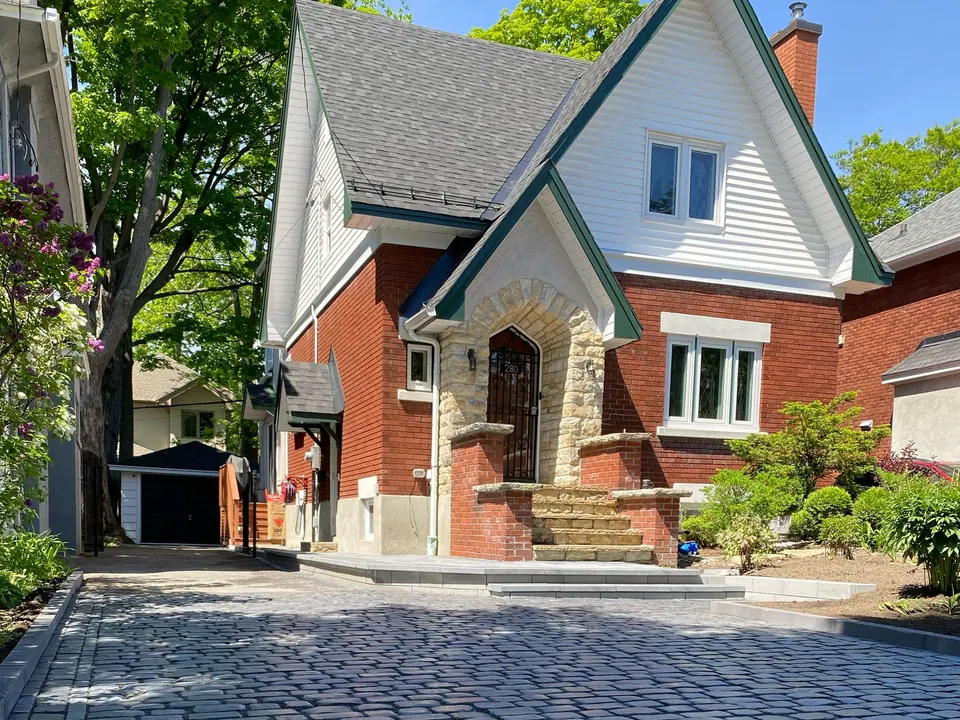
Questions we get about interlock driveways
How long does an interlock driveway last in Barrie?
With a base sized for vehicle loads, working drainage and a locked-in edge, an interlock driveway can last for decades, and individual pavers can be lifted and reset instead of replacing the whole surface. Early failures are most often base, drainage or edge-restraint problems, not the pavers themselves.
Is interlock better than asphalt or concrete for a driveway?
Asphalt costs the least up front and poured concrete sits in the middle. Interlock costs more, but it can be repaired paver by paver and it moves with freeze-thaw without cracking across the whole surface. The right choice depends on budget, how long you'll own the home and how the driveway ties into the front entrance.
How deep is the base under an interlock driveway?
Deeper than a patio base, because it carries vehicles. There is no single correct number: depth is set by soil, drainage and use, and it is written into the scope for your site.
Can you widen my driveway?
Often, yes. In Barrie, widening a driveway or changing the curb cut needs a Right-of-Way Activity (ROWA) permit from the City and has to meet zoning, lot grading and drainage. Permit needs and responsibilities are confirmed for each project.
Will a snowplow damage an interlock driveway?
Not if the surface is flush and the edges are restrained. Ask your snow contractor to use a plastic-edged blade or skid shoes, and avoid chipping ice with metal tools.
Start with a planning range.
Then we walk the site.
The cost estimator gives you a planning range first. If the number works, we visit, measure, and put the base, drainage and materials in a written scope for your property.